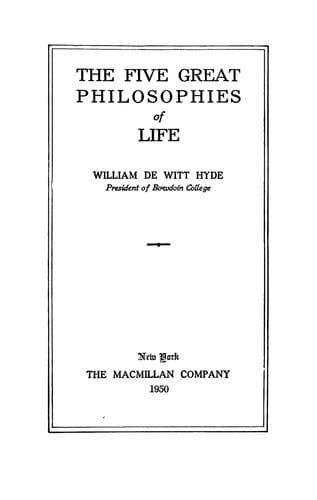
The Five Great Philosophies of LifeHyde, William De Witt
Philosophy
The Five Great Philosophies of Life
Hyde, William De Witt
Ethics; Philosophy, Ancient
The mean is not midway between zero and the maximum attainable. As
Aristotle says, "By the mean relatively to us I understand that which is
neither too much nor too little for us; and that is not one and the same
for all. For instance, if ten be too large and two be too small, if we
take six, we take the mean relatively to the thing itself, or the
arithmetical mean. But the mean relatively to us cannot be found in this
way. If ten pounds of food is too much for a given man to eat, and two
pounds too little, it does not follow that the trainer will order him
six pounds; for that also may perhaps be too much for the man in
question, or too little; too little for Milo, too much for the beginner.
And so we may say generally that a master in any art avoids what is too
much and what is too little, and seeks for the mean and chooses it--not
the absolute but the relative mean. So that people are wont to say of a
good work, that nothing could be taken from it or added to it, implying
that excellence is destroyed by excess or deficiency, but secured by
observing the mean."
The Aristotelian principle, of judging a situation on its merits, and
subordinating means to the supreme end, was never more clearly stated
than in Lincoln's letter to Horace Greeley: "I would save the Union. If
there be those who would not save the Union unless they could at the
same time save slavery, I do not agree with them. If there be those who
would not save the Union unless they could at the same time destroy
slavery, I do not agree with them. My paramount object in this struggle
is to save the Union, and is not either to save or to destroy slavery.
If I could save the Union without freeing any slave, I would do it; and
if I could save it by freeing all the slaves, I would do it; and if I
could save it by freeing some and leaving others alone, I would do that.
What I do about slavery and the coloured race, I do because I believe it
helps to save the Union; and what I forbear, I forbear because I do not
believe it would help to save the Union. I shall do less whenever I
believe what I am doing hurts the cause, and I shall do more when I
shall believe doing more will help the cause."
VI
THE ARISTOTELIAN VIRTUES AND THEIR ACQUISITION
Public-domain text, read in full here on John Shaqi.
Reviews
Reviews
No reviews yet
Be the first to share your thoughts on this work.
Elsewhere in the archive
Join the Discussion
Join the discussion
Sign in to leave a comment or review.
Sign InorCreate an account