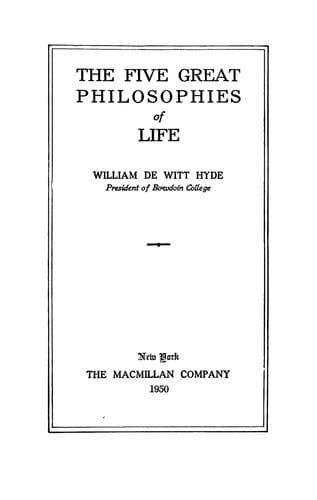
The Five Great Philosophies of LifeHyde, William De Witt
Philosophy
The Five Great Philosophies of Life
Hyde, William De Witt
Ethics; Philosophy, Ancient
His teaching may be summed up in the following:--
TEN ARISTOTELIAN COMMANDMENTS
Thou shalt devote thy utmost powers to some section of our common social
welfare.
Thou shalt hold this end above all lesser goods, such as pleasure,
money, honour.
Thou shalt hold the instruments essential to the service of this end
second only to the end itself.
Thou shalt ponder and revere the universal laws that bind ends and means
together in the ordered universe.
Thou shalt master and obey the specific laws that govern the relation of
means to thy chosen end.
Thou shalt use just so much of the materials and tools of life as the
service of thy end requires.
Thou shalt exclude from thy life all that exceeds or falls below this
mean, reckless of pleasure lost.
Thou shalt endure whatever hardship and privation the maintenance of
this mean in the service of thy end requires, heedless of pain involved.
Thou shalt remain steadfast in this service until habit shall have made
it a second nature, and custom shall have transformed it into joy.
Thou shalt find and hold a few like-minded friends, to share with thee
this lifelong devotion to that common social welfare which is the task
and goal of man.
CHAPTER V
THE CHRISTIAN SPIRIT OF LOVE
I
THE TEACHING OF LOVE
Jesus taught His philosophy of life in three ways: the personal, by
example; the artistic, by parable; and the scientific, by propositions.
The first, though most vital and effective of all, is expensive and
wasteful. For in life principles are so embedded in "muddy particulars,"
trivial and sordid details, that they are liable to get lost. The Master
may be a long time with His disciples, and yet not really be known. Even
the disciples themselves, after months of such teaching, like James and
John may not know what manner of spirit they are of. Indeed it may
become expedient for them that the Master go away, that His Spirit may
be more clearly revealed.
The artistic method, too, has drawbacks. For though it gives the
principles a new artificial setting, with carefully selected details to
catch the crowd, yet the crowd catch simply the story. Only the
initiated are instructed; those who do not already know the principles
learn nothing, but "seeing they do not see, and hearing they do not
understand," as Jesus, past master of this art though He was, so often
lamented.
Public-domain text, read in full here on John Shaqi.
Reviews
Reviews
No reviews yet
Be the first to share your thoughts on this work.
Elsewhere in the archive
Join the Discussion
Join the discussion
Sign in to leave a comment or review.
Sign InorCreate an account