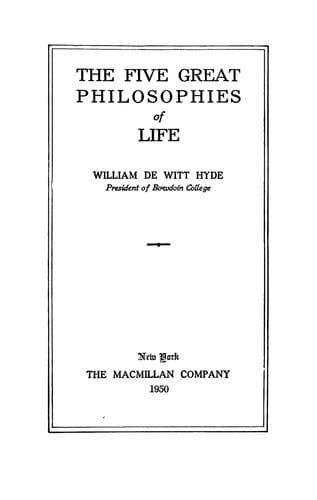
The Five Great Philosophies of LifeHyde, William De Witt
Philosophy
The Five Great Philosophies of Life
Hyde, William De Witt
Ethics; Philosophy, Ancient
The third or scientific method is dry and prosaic. It observes what
qualities go together, or refuse to go together, in the swift stream of
life; pulls them out of the stream; fixes them in concepts; marks them
by names; and states propositions about them. It may go one short step
farther: it may arrange its propositions in syllogisms, and deduce
general conclusions, or laws. It may take, for instance, as its major
premise, Love is the divine secret of blessedness. Then for its minor
premise it may take some plain observed fact, Humility is essential to
Love. Then the conclusion or law will be, The humble share the divine
life and all the blessings it brings. Blessed are the poor in spirit,
for theirs is the Kingdom of Heaven.
Of course no one but a pedant draws out his teaching in this laboured
logical form. The syllogism is condensed; the major, and perhaps even
the minor, premise is omitted, and often only the conclusion appears.
At its best this method is hard and dry; yet this is the method employed
in such sayings as those handed down in the summary called the Sermon on
the Mount. Perhaps that is why the teaching of the "Sermon," in spite of
its clear-cut form, is much less studied and understood than the
teaching of Jesus' life and parables. To recover this largely lost
teaching one must warm and moisten the cold, dry terms; supply, when
necessary, omitted premises; use some one word rather than many for the
often suppressed middle term; and so draw out the latent logic that
underlies these laws.
The middle term of all this argument is Love. For that old-fashioned
word, in spite of its sentimental associations, much better than its
modern scientific synonyms, such as the socialising of the self,
expresses that outgoing of the self into the lives of others, which,
according to Jesus, is the actual nature of God, the potential nature of
man, the secret of individual blessedness and the promise of social
salvation.
In the two or three cases where the logic of His principle, applied to
our complex modern life, points clearly to a modification of His literal
precepts, as in the management of wealth and the bestowal of charity, I
shall not hesitate to put the logic of the teaching in place of the
letter of the precept, citing the latter afterward for comparison.
A logical commentary like this will be most helpful if it reverses the
order usual in commentaries of mere erudition, and introduces the steps
of the argument before rather than after the passage they seek to make
clear.
In whichever of the three ways it is taught, Love shines by its own
light and speaks with its own authority to all who have eyes to see and
ears to hear.
A person who loves carries with him a generous light-heartedness, a
genial optimism, which show all his friends that he has found some
secret which it is worth their while to learn.
Public-domain text, read in full here on John Shaqi.
Reviews
Reviews
No reviews yet
Be the first to share your thoughts on this work.
Elsewhere in the archive
Join the Discussion
Join the discussion
Sign in to leave a comment or review.
Sign InorCreate an account