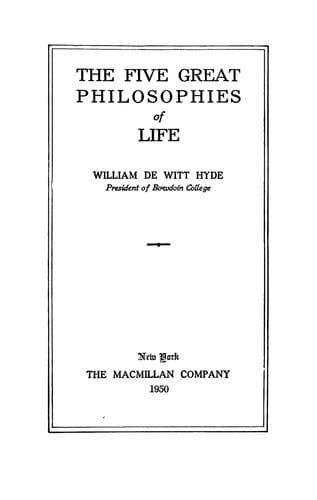
The Five Great Philosophies of LifeHyde, William De Witt
Philosophy
The Five Great Philosophies of Life
Hyde, William De Witt
Ethics; Philosophy, Ancient
Is the world a happier, holier, better world because we are here in it,
helping on God's good-will for men? If that be the grand, comprehensive
purpose of our lives, honestly cherished, frankly avowed, systematically
cultivated, then, no matter how far below perfection we may fall, that
single purpose, in spite of failure, defeat, and repented sin, pulls us
through. If we have this Spirit of Love in our hearts, and if with
Christ's help we are trying to do something to make it real in our lives
and effective in the world, our eternal salvation is assured. On the
other hand, is there a single point on which we deliberately are working
evil? Is the lot of any poor man harder, or the life of any unhappy
woman more sad and bitter, for aught that we have done or left undone?
Is any good institution the weaker, or any bad custom more prevalent,
for aught that we are deliberately and persistently withholding of help
or contributing of harm? If so, if in any one point we are consciously
and unrepentingly arrayed against God's righteous purpose, and the human
welfare which is dear to God; if there is a single point on which we are
deliberately setting aside His righteous will, and doing intentional
evil to the humblest of His children; then, notwithstanding our high
rank on other matters, our lack of the right purpose, at even a single
point, makes us guilty of the whole; we are unfit for His kingdom.
Jesus' principle of Love, though for clearness and incisiveness often
stated in terms of mere altruism, or regard for others, yet taken in its
total context, in the light of His never absent reference to the
Father's will and the Kingdom of Heaven, is much deeper and broader than
that. It gives each man his place and function in the total beneficent
system which is the coming Kingdom of God, and then treats him not
merely as he may wish to be treated, or we may wish to treat him, but as
his place and function in that system require.
Mere altruism is often weakly kind, making others feebly dependent on
our benefactions instead of sturdily self-supporting; making others
unconsciously egotistic as the result of our superfluous ministrations
or uncritical indulgence; and even fostering a subtle egotism in
ourselves, as the result of the fatal habit of doing the easy, kind
thing rather than the hard, severe thing that is needed to lift them to
their highest attainment. A true mother is never half as sentimentally
altruistic toward her child as a grandmother or an aunt; she does not
hesitate to reprove and correct, when that is what the child needs to
suppress the low and lazy, and rouse the higher and stronger self. The
just administrator discharges the incompetent and exposes the dishonest
employee, not merely because the good of the whole requires it; but
because even for the person discharged or exposed, that is better than
it would be to allow him to drag out an unprofitable and cumbersome life
in tolerated uselessness or countenanced graft.
Public-domain text, read in full here on John Shaqi.
Reviews
Reviews
No reviews yet
Be the first to share your thoughts on this work.
Elsewhere in the archive
Join the Discussion
Join the discussion
Sign in to leave a comment or review.
Sign InorCreate an account