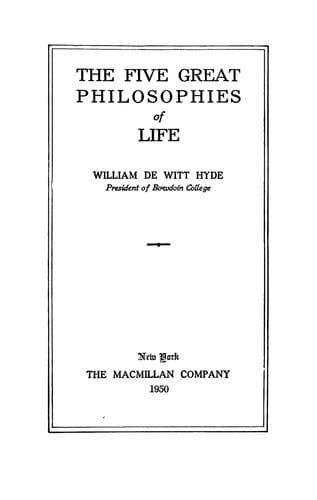
The Five Great Philosophies of LifeHyde, William De Witt
Philosophy
The Five Great Philosophies of Life
Hyde, William De Witt
Ethics; Philosophy, Ancient
"Treat both others and yourself as their place and yours in God's coming
Kingdom require;" that is the Golden Rule in its complete form. "All
things, therefore, whatsoever ye would that men should do unto you"
(remembering that both you and they have places and functions in the
Father's Kingdom of Love); "even so do ye also unto them: for this is
the law and the prophets."
This fulfilment of law is a very different thing from selfishly breaking
the law. That such a reformer as Jesus ever took the conservative side
of any question seems at first sight so preposterous that most candid
critics believe that He never said the words attributed to Him about
breaking one of the least of these commandments, or else that He said
them in a lost context which would greatly alter their meaning. That,
however, is not quite sure. For Love at its best is never rudely
iconoclastic. Every good law in its original intent is aimed to lift
men out of their sensuality and selfishness into at least an outward
conformity to the requirements of social well-being. And however
grotesque, fantastic, and superfluous such a law under changed
conditions may become, its original intent will always keep it sacred
and precious, even after its purpose can be accomplished better without
it. To fulfil is not to destroy, or to take delight in destruction.
"Think not that I came to destroy the law or the prophets; I came not to
destroy, but to fulfil. For verily I say unto you, Till heaven and earth
shall pass away, one jot or one tittle shall in no wise pass away from
the law, till all things be accomplished."
At the same time Love is always changing and superseding laws and
institutions by pressure of adjustment to the changing demands of
individual and social well-being. Laws and institutions are made for
men, rather than men for institutions and laws; and the instant an old
law ceases to serve a new need in the best possible way, Love erects the
better service into a new law or institution, superseding the old. Any
law that fails to promote the physical, mental, social, and spiritual
good of the persons and the community concerned, thereby loses Love's
sanction and becomes obsolete. Law for law's sake, rather than for the
sake of man and society, is the flat denial of Love. To exalt any
tradition, institution, custom, or prohibition above the human and
social good it has ceased to serve, is to sink to the level of the
scribe and Pharisee--the deadliest enemies of Jesus, and all for which
He stood. "For I say unto you, that except your righteousness shall
exceed the righteousness of the scribes and Pharisees, ye shall in no
wise enter into the kingdom of heaven."
Public-domain text, read in full here on John Shaqi.
Reviews
Reviews
No reviews yet
Be the first to share your thoughts on this work.
Elsewhere in the archive
Join the Discussion
Join the discussion
Sign in to leave a comment or review.
Sign InorCreate an account