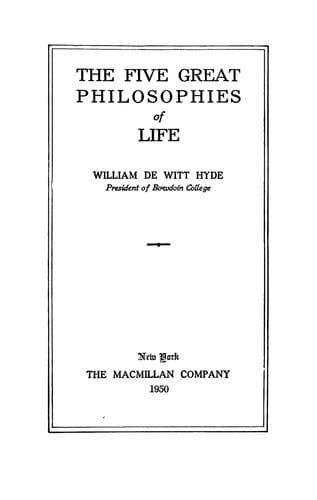
The Five Great Philosophies of LifeHyde, William De Witt
Philosophy
The Five Great Philosophies of Life
Hyde, William De Witt
Ethics; Philosophy, Ancient
"Ye have heard that it was said, Thou shalt not commit adultery; but I
say unto you, that every one that looketh on a woman to lust after her
hath committed adultery with her already in his heart. And if thy right
eye causeth thee to stumble, pluck it out, and cast it from thee; for it
is profitable for thee that one of thy members should perish, and not
thy whole body be cast into hell. And if thy right hand causeth thee to
stumble, cut it off, and cast it from thee; for it is profitable for
thee that one of thy members should perish, and not thy whole body go
into hell."
Divorce is a confession of failure in Love's supreme undertaking. No two
Christians, who have caught and kept alive the Spirit of Love in the
married state, ever were or ever will be, ever wished to be or ever can
be, divorced. No one Christian who has the true Christian Spirit of Love
toward husband or wife will ever seek divorce unless it be under such
circumstances of infidelity or brutality, neglect or cruelty, as render
the continuance of the relation a fruitless casting of the pearls of
affection before the swinishness of sensuality. The determination of the
grounds on which divorce shall be granted belongs to the sphere of the
state, and is a problem of social self-protection. The Christian church
makes a serious mistake when it spends its energies in trying to build
up legal barriers against divorce. Its real mission at this point is to
build up in the hearts of its adherents the Spirit of Love which will
make marriage so sweet and sacred that those who once enter it will
find, as all true Christians do find, divorce intolerable between two
Christians; and tolerable even for one Christian only as a last resort
against hopeless and useless degradation. To translate Christ's Spirit
into the life of the family is a much more Christian thing to do than to
attempt to enact this or that somewhat general and enigmatical answer of
His into civil law. It is generally a mistake, a departure from the
Spirit of the Master, when the Christian community as such turns from
its specific task of positive upbuilding of personality to the legal
prohibition of the things that are contrary to the Christian Spirit.
Laws and prohibitions, statutes and penalties against drunkenness,
Sabbath-breaking, theft, murder, gambling, and divorce, we must have.
But those laws and penalties are best devised and enforced by the state,
as the representative of the average sentiment of the community as a
whole, rather than by the distinctively Christian element in the
community, which in the nature of things is very far above the average
sentiment. Undoubtedly the Christian Spirit is the only force strong
enough to save the family from degeneration and dissolution in this
intensely individualistic, independent, materialistic, luxurious age.
But we must rely mainly on the Spirit working within, not on a law
imposed from without; on the healing touch of the gentle Master, not on
Public-domain text, read in full here on John Shaqi.
Reviews
Reviews
No reviews yet
Be the first to share your thoughts on this work.
Elsewhere in the archive
Join the Discussion
Join the discussion
Sign in to leave a comment or review.
Sign InorCreate an account