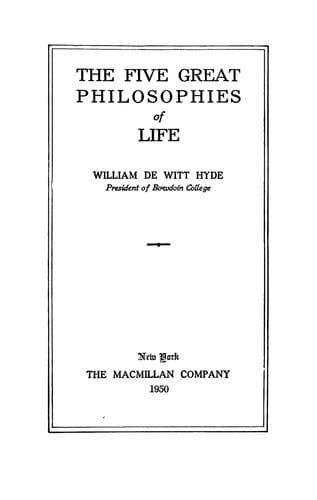
The Five Great Philosophies of LifeHyde, William De Witt
Philosophy
The Five Great Philosophies of Life
Hyde, William De Witt
Ethics; Philosophy, Ancient
Just because Love is so costly, it has a host of counterfeits. These
counterfeits are chiefly devices for gaining the rewards and honours of
Love, without the effort and sacrifice of loving. One of the most
obvious rewards of Love is being thought kind, generous, good. But this
can be secured, apparently, by professing religion, joining the church,
repeating the creed, giving money to the poor, subscribing large sums to
good causes,--all of which are much cheaper and easier than being kind,
and true, and faithful, and considerate in the home, on the farm, in the
factory, in the store. Yet Jesus tells us that unless we have Love in
the close and intimate relations of our domestic, economic, social, and
political life, all symbols of its presence elsewhere, all "services"
directed otherwise, become intolerable nuisances, whose places would be
better filled, and whose work better done, if they were once well out of
the way and decently buried. All this, however, is not to deny, but by
contrast to affirm, the great indispensable uses of symbols, officers,
and institutions that are genuinely and effectively devoted to the
cultivation and propagation of Love.
The pure gold of the Spirit is most conveniently and effectually
circulated when mixed with the alloy of rites, ceremonies, creeds,
officers, and organisations. Though no essential part of the pure
Gospel, yet these forms and observances, these bishops and clergy, these
covenants and confessions, are as practically useful for the maintenance
and spread of the Christian Spirit as courts and constitutions,
governors and judges, are for the orderly conduct of the state. Their
authority is founded on their practical utility. When their utility
ceases, when they come to obscure rather than reveal the Spirit they are
intended to express, then schism and reformation serve the same
beneficent purpose in the church that declarations of independence and
revolution have so often achieved in the state. That form of church
government is best which in any given age and society works best; and
this may well be concentrated personal authority in one set of
circumstances, and democratic representative administration in another.
Each has its advantages and its disadvantages.
Public-domain text, read in full here on John Shaqi.
Reviews
Reviews
No reviews yet
Be the first to share your thoughts on this work.
Elsewhere in the archive
Join the Discussion
Join the discussion
Sign in to leave a comment or review.
Sign InorCreate an account