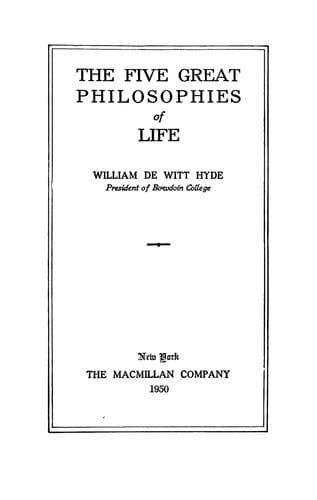
The Five Great Philosophies of LifeHyde, William De Witt
Philosophy
The Five Great Philosophies of Life
Hyde, William De Witt
Ethics; Philosophy, Ancient
Modes of worship rest on the same practical basis. Spontaneous prayer or
elaborate ritual, much or little participation by the people, long or
short sermons, prayer-meetings or no prayer-meetings,--all are to be
determined by the test of practical experience. It is absurd to profess
to draw hard and fast rules about these matters from the precept or
practice of Jesus and His Apostles, or the early church fathers, working
as they did under conditions so widely different from our own. Probably
centralised authority and elaborate ritual are most effective when
bishops and priests can be found who will not abuse their power for
their own aggrandisement. Until then, more democratic forms of worship
and of government are doubtless more expedient. The friendly competition
of the two systems side by side helps to keep sacerdotalism modest and
make independency effective.
Creeds likewise have their practical usefulness, especially in times of
theological ferment and transition, serving the purposes of party
platforms in a political campaign. But it is the grossest perversion of
their function to make assent to them obligatory on all who wish to
enjoy the most intimate Christian fellowship, or to test Christian
character by their formulas. One might as well refuse citizenship to
every person who could not assent to every word in some party platform
or other. The creed is an intellectual formulation of the results of
Christian experience, interpreting the Christian revelation; and it
will vary from age to age with ripening experience, and maturer views of
the content of the revelation. No creed was altogether false at the time
of its formulation. No creed in Christendom is such as every intelligent
Christian can honestly assent to. The attempt to make creed subscription
a test of church membership, or even a condition of ministerial
standing, is sure to confuse intellectual and spiritual things to the
serious disadvantage of both. The most sensitively honest men will more
and more decline to enter the service of the church, until subscription
to antiquated formulas, long since become incredible to the majority of
well-trained scholars, ceases to be required either literally or "for
substance of doctrine." It is sufficient that each candidate for the
ministry be asked to make his own statement, either in his own words or
in the words of any creed he finds acceptable, leaving it for his
brethren to decide whether or not such intellectual statement is
consistent with that spiritual service which is to be his chief concern.
Unless Christianity, in the persons of its leaders as well as of its
laity, can breathe as free an intellectual atmosphere as that of Stoic
or Epicurean, Plato or Aristotle, it will at this point prove itself
their inferior. Infinitely superior as it is in every other respect, it
is a burning shame that its timid and conservative modern adherents
should endeavour, at this point of absolute intellectual openness and
Public-domain text, read in full here on John Shaqi.
Reviews
Reviews
No reviews yet
Be the first to share your thoughts on this work.
Elsewhere in the archive
Join the Discussion
Join the discussion
Sign in to leave a comment or review.
Sign InorCreate an account