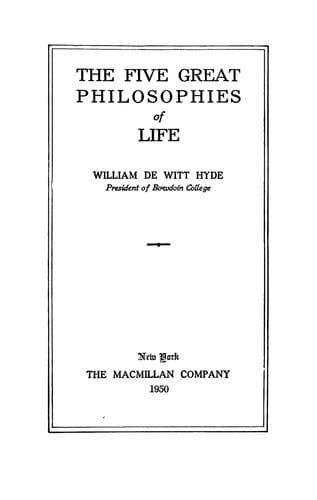
The Five Great Philosophies of LifeHyde, William De Witt
Philosophy
The Five Great Philosophies of Life
Hyde, William De Witt
Ethics; Philosophy, Ancient
integrity, to place it at a disadvantage with the least noble of its
ancient competitors. The pure Spirit of Love will win the devotion of
all honest hearts and candid minds. But the insistence on these
antiquated formulas is sure to repel an increasing number of the most
thoughtful and enlightened from organised Christian fellowship. The only
serious reason for preferring the independent to the hierarchical forms
of church organisation at the present time is the tendency of the latter
to keep up these forms of intellectual imposition and imposture. Until
the church as a whole shall rise to the standards of intellectual
honesty now universally prevalent in the world of secular science, the
mission of the independent protest will remain but partially fulfilled.
"Ye are the salt of the earth; but if the salt have lost its savour,
wherewith shall it be salted? It is thenceforth good for nothing, but to
be cast out and trodden under foot of men."
Any thought of the reputation or respectability or honour a right act
will bring, just because it puts something else in place of Love,
destroys the rightness of the act and the righteousness of the doer.
Righteousness will always remain a dry, dreary, forbidding, impossible
thing until we welcome right as the service of those whom we love, and
the promotion of interests we share with them; and shrink from wrong as
what harms them and defeats our common ends. Without Love, righteousness
either dries up into a cold, hard asceticism, or evaporates into a
hollow, formal respectability; and in one way or the other misses the
spontaneity and expansion of soul which is Love's crown and joy. "Take
heed that ye do not your righteousness before men, to be seen of them:
else ye have no reward of your Father which is in heaven."
Love is too intent on its objects to be aware of itself or call
attention to its own operations. The air of doing a favour takes all the
Love out of an act; for Love gives so simply and quietly that it seems
to ask rather than bestow the favour. In this way both giver and
receiver together share Love's distinctive reward of two lives bound
together as one in the common Love of the Father.
"When therefore thou doest alms, sound not a trumpet before thee, as the
hypocrites do in the synagogues and in the streets, that they may have
glory of men. Verily I say unto you, They have received their reward.
But when thou doest alms, let not thy left hand know what thy right
hand doeth, that thine alms may be in secret; and thy Father which seeth
in secret shall recompense thee."
Public-domain text, read in full here on John Shaqi.
Reviews
Reviews
No reviews yet
Be the first to share your thoughts on this work.
Elsewhere in the archive
Join the Discussion
Join the discussion
Sign in to leave a comment or review.
Sign InorCreate an account