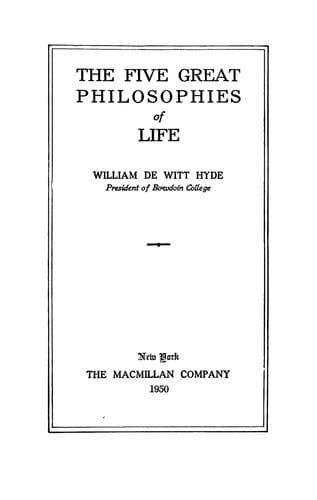
The Five Great Philosophies of LifeHyde, William De Witt
Philosophy
The Five Great Philosophies of Life
Hyde, William De Witt
Ethics; Philosophy, Ancient
"Every one therefore which heareth these words of mine, and doeth them,
shall be likened unto a wise man, which built his house upon a rock; and
the rain descended, and the floods came, and the winds blew, and beat
upon that house, and it fell not, for it was founded upon the rock. And
every one that heareth these words of mine, and doeth them not, shall be
likened unto a foolish man, which built his house upon the sand; and the
rain descended, and the floods came, and the winds blew, and smote upon
that house, and it fell; and great was the fall thereof."
IV
THE WHOLE-HEARTEDNESS OF LOVE
Love asks for the whole heart or nothing; and all the heart has, be it
little or much, must go with it. The pursuit or possession of wealth, as
an end in itself, or a means to mere selfish ends, will drive Love out
of the soul.
All the wealth we can give to Love's service is most useful and welcome;
but the retention of any for miserly pride, or vain ostentation, or
indolent uselessness for ourselves or our children, fills the heart so
full of self that Love can find there no room. Not that giving away all
one has is essential or desirable; but that every dollar one gives,
spends, keeps, invests, or controls be held subject to the orders of
Love.
Wealth is not so essential to the Christian as it was to Epicurus and
Aristotle, for God can be glorified and man can be served with very
little furniture of fortune; and therefore the Christian is able, in
whatsoever material state he is, therewith to be content. On the other
hand, the Christian cares more for money than either the Stoic or Plato;
for there are ranges in God's universe of beauty, truth, and goodness
which cannot be æsthetically appreciated and artistically and
scientifically appropriated without large expenditure of labour and the
wealth by which labour is supported; and there are wide spheres of
business enterprise and social service essential to human welfare which
only the rich man or nation can effectively promote. Divine and human
service is possible in poverty; it is more effective and at the same
time more difficult in wealth. The Christian rich and the Christian poor
serve the same Lord, and have the same Spirit; but the accomplishment of
the Christian rich man can be so much greater than that of the
Christian widow with her mite, that the Christian who is strong enough
to stand it is in duty bound to treat money as a talent which in all
just ways he ought to multiply. On the contrary, the moment it begins to
make him less sympathetic, less generous, less thankful, less
responsible, he must give it away as the only alternative to the loss of
his soul, the deterioration of his personality.
Public-domain text, read in full here on John Shaqi.
Reviews
Reviews
No reviews yet
Be the first to share your thoughts on this work.
Elsewhere in the archive
Join the Discussion
Join the discussion
Sign in to leave a comment or review.
Sign InorCreate an account