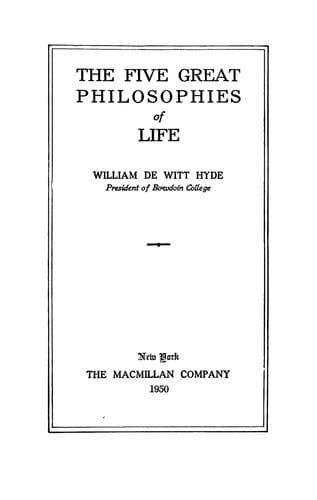
The Five Great Philosophies of LifeHyde, William De Witt
Philosophy
The Five Great Philosophies of Life
Hyde, William De Witt
Ethics; Philosophy, Ancient
"Lay not up for yourselves treasures upon the earth, where moth and rust
doth consume, and where thieves break through and steal; but lay up for
yourselves treasure in heaven, where neither moth nor rust doth consume,
and where thieves do not break through nor steal, for where thy treasure
is, there will thy heart be also."
Toward science and art, business and politics, the application of the
Christian Spirit is different from anything we have met before. The
Christian will not shirk these things, like the Epicurean and the Stoic;
because they are ways of serving that truth, beauty, welfare, and order
which are included in the Father's will for all His human children. In
all these things we are co-workers with God for the good of man.
Diligence and enthusiasm, devotion and self-sacrifice in one or more of
these directions is the imperative duty, the inestimable privilege of
every one who would be a grateful and obedient son of God, a helpful and
efficient brother to his fellow-men.
Yet in all his devotion to science or art, in all the energy with which
he gives himself to business or politics, the Christian can never forget
that God is greater than any one of these points at which we come in
contact with Him; and that, when we have done our utmost in one or
another of these lines, we are still comparatively unprofitable servants
in His vast household. As God is more than the thing at which we work,
so the Christian, through relation to Him, is always more than his work.
He never lets his personality become absorbed and evaporated in the work
he does; but ever renews his personal life at the fountain which is
behind the special work he undertakes to do. Thus the true Christian is
never without some useful social work to do; and he never lets himself
get lost in doing it. To keep this balance of energy in the task and
elevation above it, which enables one to take success without elation
and bear failure without depression, is perhaps the crowning achievement
of practical Christianity.
"The lamp of the body is the eye; if therefore thine eye be single, thy
whole body shall be full of light. But if thine eye be evil, thy whole
body shall be full of darkness. If, therefore, the light that is in thee
be darkness, how great is the darkness! No man can serve two masters;
for either he will hate the one, and love the other, or else he will
hold to one, and despise the other. Ye cannot serve God and mammon."
Public-domain text, read in full here on John Shaqi.
Reviews
Reviews
No reviews yet
Be the first to share your thoughts on this work.
Elsewhere in the archive
Join the Discussion
Join the discussion
Sign in to leave a comment or review.
Sign InorCreate an account