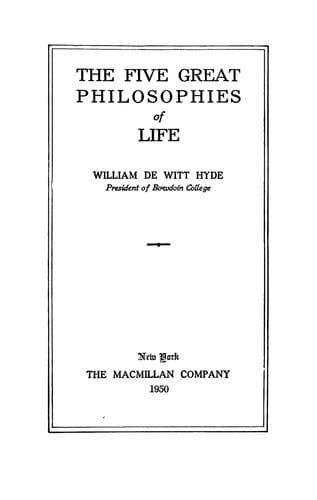
The Five Great Philosophies of LifeHyde, William De Witt
Philosophy
The Five Great Philosophies of Life
Hyde, William De Witt
Ethics; Philosophy, Ancient
All pleasure that comes from healthy exercise of body, rational exercise
of mind, sympathetic expansion of the affections, strenuous effort of
the will, in just and generous living, is at the same time a glorifying
of God and an enrichment of ourselves. All pleasure which sacrifices the
vigour of the body to the indulgence of some separate appetite, all
pleasure which enslaves or degrades or embitters the persons from whom
it is procured, all pleasure which breaks down the sacred institutions
on which society is founded,--is shameful and debasing, a sin against
God, and a wrong to our own souls. The Christian will forego many
pleasures which Epicurus and even Aristotle would permit, because he is
infinitely more sensitive than they to the effect his pleasures have on
poor men and unprotected women whose welfare these earlier teachers did
not take into account. On the other hand, the Christian will enter
heartily into the joys of pure domestic life, and the delights of
struggle with untoward social and political conditions, from which Plato
and the Stoics thought it honourable to withdraw. Where God can be
glorified and men can be served, there the Christian will either find
his pleasure, or with optimistic art, create a pleasure that he does not
find.
"Moreover when ye fast, be not, as the hypocrites, of a sad countenance;
for they disfigure their faces, that they may be seen of men to fast.
Verily I say unto you, They have received their reward. But thou, when
thou fastest, anoint thy head, and wash thy face, that thou be not seen
of men to fast, but of thy Father which is in secret; and thy Father,
which seeth in secret, shall recompense thee."
Just because Love includes the interests of all the persons we deal
with, it excludes all mean, selfish traits from our hearts. There can be
no pride and guile, no lust and cruelty, no avarice and hypocrisy, no
malice and censoriousness, in a heart which welcomes to its interest and
affection, and serves and loves as its own, the aims and needs of its
fellows. That is why Love's true disciples are few, and the slaves of
selfishness many. Ask how many,--not entirely succeed, for none do,--but
how many make it the constant aim of their lives to treat others as more
widely extended aspects of themselves, and, in order to do that,
endeavour to keep out all the greed, hate, lust, pride, envy, jealousy,
that would draw lines between self and others, and we see the answer:
that the way must be narrow, a way few find, and still fewer follow when
found.
"Enter ye in by the narrow gate; for wide is the gate, and broad is the
way, that leadeth to destruction, and many be they that enter in
thereby. For narrow is the gate, and straitened the way, that leadeth
unto life, and few be they that find it."
V
THE CULTIVATION OF LOVE
Public-domain text, read in full here on John Shaqi.
Reviews
Reviews
No reviews yet
Be the first to share your thoughts on this work.
Elsewhere in the archive
Join the Discussion
Join the discussion
Sign in to leave a comment or review.
Sign InorCreate an account