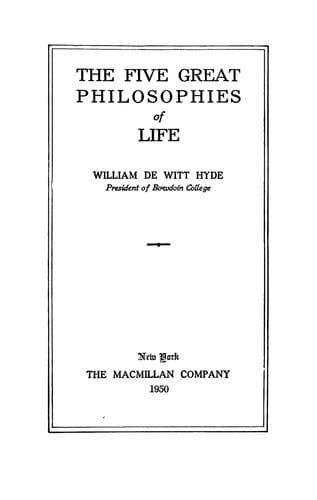
The Five Great Philosophies of LifeHyde, William De Witt
Philosophy
The Five Great Philosophies of Life
Hyde, William De Witt
Ethics; Philosophy, Ancient
Though material means sought as ends are fatal to Love, Love's ends kept
in view insure needed means. To worry about to-morrow is to fail in
devotion to the tasks of to-day, and so spoil both days. To do our best
work to-day is to gain power for to-morrow. Competition complicates, but
does not render insoluble, the problem of making all that we have and
all that we do express Love to all whom our action affects. To be sure,
there are city slums, uninsured accidents and sickness, unsanitary
tenements, unjust conditions of labour, where even the service of Love
does not bring to the worker appropriate means and rewards; but it is
because Love has not quite kept pace at these points with swift-moving
modern conditions. But public spirit, political progress, economic
reform, are more sensitive to these violations of its laws than ever
before, and eagerly bent on finding and applying the remedy,--more Love
of all for each, and each for all.
"But seek ye first his kingdom, and his righteousness, and all these
things shall be added unto you. Be not therefore anxious for the morrow,
for the morrow will be anxious for itself. Sufficient unto the day is
the evil thereof."
Love throws off all that hampers its action, as a runner his coat for a
race. Love requires the sound body, the clear mind, the strong will, the
sensitive heart, and foregoes all indulgences that impair these things,
though in themselves innocent as eating and drinking. Yet Love makes no
fuss about its sacrifices, takes them as a simple matter of course, not
worth mentioning; for what Love gives up in mere sensuous indulgence is
as nothing to the widened affections and enlarged interests gained. To
be solemn or sad over what we give up, to proclaim or parade one's
self-denials, would be an insult to Love; it would show that the persons
we love and the causes we serve are not really as dear to our hearts as
the pitiful things we forego for their sake--would show that our Love
was a sham.
Public-domain text, read in full here on John Shaqi.
Reviews
Reviews
No reviews yet
Be the first to share your thoughts on this work.
Elsewhere in the archive
Join the Discussion
Join the discussion
Sign in to leave a comment or review.
Sign InorCreate an account