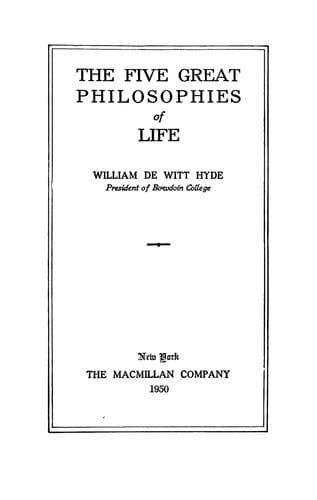
The Five Great Philosophies of LifeHyde, William De Witt
Philosophy
The Five Great Philosophies of Life
Hyde, William De Witt
Ethics; Philosophy, Ancient
Christian sacrifice closely resembles Greek temperance and courage.
There is, however, this essential distinction. The Christian takes on
not merely the pains and privations which are essential to his personal
welfare, or the welfare of his community or state; he takes on whatever
suffering the Father's Love for all His children calls him to undergo;
gives up whatever indulgences the service of Christ requires him to
dispense with; adopts whatever mingling of hardship and self-denial will
keep him in most effective and sympathetic fellowship with those who
have discovered the same great spiritual secret as himself. Thus, though
to the uninitiated outsider much of his life looks hard and severe, on
the inside it is easy and light; for the companionship with the Father,
with Christ, and with Christian people is so much greater and dearer
than the material and sensuous delights it may incidentally take away,
that on the inside it does not wear the aspect of loss and sacrifice at
all, but rather that of a glory and a gain. Still, since this element
of pleasant things foregone, and hard things endured, is ever present,
and since it has to be judged by people on the outside as well as by
those on the inside of the experience, in recognition of this truth
Christianity has made its symbol before the uninitiated world the cross.
As in the life of the Master, so in the life of every faithful disciple,
the cross must be borne, the perpetual sacrifice must be made, as the
price of Love's presence in a world of selfishness and hate; but the
cross is transfigured into a crown of rejoicing, the sacrifice is
transformed into privilege and pleasure by those precious personal
relationships which are the supreme glory and gladness of the soul, and
which could be maintained on no cheaper terms. The sacrifice that the
Christian makes to get his Father's will, his Master's mission,
accomplished in the world which so sorely needs it, is like the
sacrifice a mother makes for her sick and suffering child,--the dearest
and sweetest experience of life. The cross thus gladly borne, the yoke
of sacrifice thus unostentatiously assumed, is the supreme expression of
the Christian Spirit.
Like all high-cost things, sacrifice for Love's sake carries a high
premium. It admits, as nothing else does, to the inner circle of the
immortal lovers of their fellows, to the intimate fellowship of the
Lord of Love, Jesus Christ.
Public-domain text, read in full here on John Shaqi.
Reviews
Reviews
No reviews yet
Be the first to share your thoughts on this work.
Elsewhere in the archive
Join the Discussion
Join the discussion
Sign in to leave a comment or review.
Sign InorCreate an account