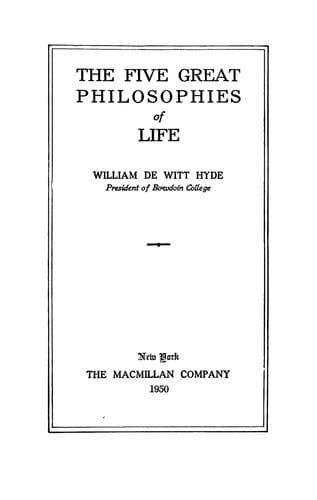
The Five Great Philosophies of LifeHyde, William De Witt
Philosophy
The Five Great Philosophies of Life
Hyde, William De Witt
Ethics; Philosophy, Ancient
The Epicurean's varied and spontaneous joy in life is not diminished,
but enhanced, by the Christian Spirit, which multiplies this joy as many
times as there are persons whom one knows and loves. The Epicurean lives
in the little world of himself, and a few equally self-centred
companions. The Christian lives in the great world of God, and shares
its joys with all God's human children. It is the absence of this larger
world, the exclusive concern for his own narrow pleasures, that makes
the consistent Epicurean, with all his polish and charm, the essentially
mean and despicable creature we found him to be.
To be sure, Mill, Spencer, and others have endeavoured to graft the
altruistic fruits of Christianity on to the old Epicurean stock. There
is this great difference, however, between such Christianised
Epicureanism as that of Mill and Spencer, and Christianity itself.
These systems have no logical bridge, no emotional bond by which to pass
from the pleasures of self to the pleasures of others. They can and do
point out the incompleteness of merely egoistic Epicureanism; they
exhort us to care for the pleasures of others as we do for our own. But
the logical nexus, the moral dynamic, the spiritual motive, is lacking
in these systems; and consequently these systems fail to work, except
with the few highly altruistic souls who need no spiritual physician.
This logical bond, this moral dynamic, this spiritual motive which
impels toward altruistic conduct, the Christian finds in Christ. He
certainly did love all men, and care for their happiness as dearly as He
cared for His own. But this same Christ is the Christian's Lord and
Master and Friend. Yet friendship for Him, the acceptance of Him as Lord
and Master, is a contradiction in terms, unless one is at the same time
willing to cultivate His Spirit, which is the Spirit of service, the
Spirit which holds the happiness and welfare of others just as sacred
and precious as one's own. He that hath not this Spirit of Christ is
none of His. Hence what men like Mill and Spencer preach as a duty, and
support by what their critics have found to be very inadequate and
fallacious logical processes, Christianity proclaims as a fact in the
nature of God, as embodied in Christ, and a condition of the divine life
for everyone who desires to be a child of God, a follower and friend of
Jesus Christ. Christianity, therefore, includes everything of value in
Epicureanism, and infinitely more. It has the Epicurean gladness without
its exclusiveness, its joy without its selfishness, its naturalness
without its baseness, its geniality without its heartlessness.
Public-domain text, read in full here on John Shaqi.
Reviews
Reviews
No reviews yet
Be the first to share your thoughts on this work.
Elsewhere in the archive
Join the Discussion
Join the discussion
Sign in to leave a comment or review.
Sign InorCreate an account