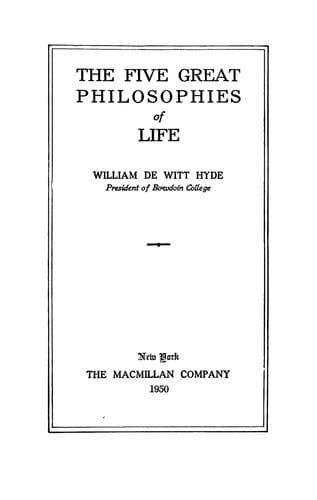
The Five Great Philosophies of LifeHyde, William De Witt
Philosophy
The Five Great Philosophies of Life
Hyde, William De Witt
Ethics; Philosophy, Ancient
In like manner Christianity takes up all that is true in the Stoic
teaching, without falling into its hardness and narrowness. The truth of
the Stoic teaching consisted in its power to transform into an
expression of the man himself, and of the beneficent laws of Nature,
whatever outward circumstance might befall him, Now put in place of the
abstract self the love of the perfect Christ, and instead of universal
law the loving will of the Father for all His children, and you have a
deepened, sweetened, softened Stoicism which is identical with a sturdy,
strenuous, and virile Christianity.
If a man has in his heart the earnest desire to be like Christ, and to
do the things that help to carry out Christ's Spirit in the world, it is
absolutely impossible that he should ever find himself in a situation
where what he most desires to do cannot be done. Now a man who in every
conceivable situation can do what he most desires to do is as completely
"master of his fate" and "captain of his soul" as the most strenuous
Stoic ever prayed to be. And yet he is saved from the coldness and
hardness and repulsiveness of the mere Stoic, because the object of his
devotion, the aim of his assertion, is not his own barren, frigid,
formal self, but the kindly, sympathetic, loving Christ, whom he has
chosen to be his better self. Like the Stoic, he brings every thought
into captivity; but it is not the captivity of a prison, the empty
chamber of his individual soul, swept and garnished; it is captivity to
the most gracious and gentle and generous person the world has ever
known,--it is captivity to Christ.
When misfortune and calamity overtakes him, he transforms it into a
blessing and a discipline, not like the mere Stoic through passive
resignation to an impersonal law, as of gravitation, or electricity, or
bacteriology, but through active devotion to that glory of God which is
to be furthered mainly by kindness and sympathy and service to our
fellow-men. The man who has this love of Christ in his heart, and who is
devoted to the doing of the Father's loving will, can exclaim in every
untoward circumstance, "I can do all things in Him that strengtheneth
me." He can shout with more than Stoic defiance: "O death, where is thy
sting? O grave, where is thy victory?" In all the literature of Stoic
exultation in the face of frowning danger and impending doom, there is
nothing that can match the splendid outburst of the great Apostle: "Who
shall separate us from the love of Christ? Shall tribulation, or
anguish, or persecution, or famine, or nakedness, or peril, or sword?
Nay, in all these things we are more than conquerors through Him that
loved us. For I am persuaded that neither death, nor life, nor angels,
nor principalities, nor things present, nor things to come, nor powers,
nor height, nor depth, nor any other creature, shall be able to separate
us from the love of God, which is in Christ Jesus our Lord."
Public-domain text, read in full here on John Shaqi.
Reviews
Reviews
No reviews yet
Be the first to share your thoughts on this work.
Elsewhere in the archive
Join the Discussion
Join the discussion
Sign in to leave a comment or review.
Sign InorCreate an account