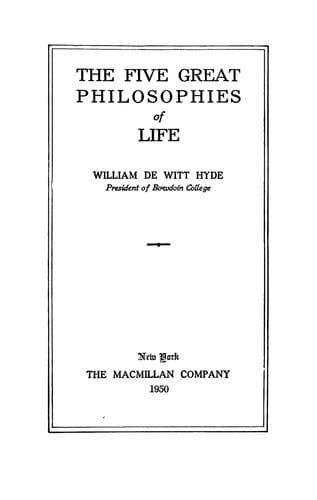
The Five Great Philosophies of LifeHyde, William De Witt
Philosophy
The Five Great Philosophies of Life
Hyde, William De Witt
Ethics; Philosophy, Ancient
Everything that we found noble, and strong, and brave in Stoicism we
find also here; the power to transform external evil into internal good,
and to hold so tightly to our self-chosen good that no power in earth or
heaven can ever wrest it from us,--a good so universal that the
circumstance is inconceivable in which it would fail to work. Yet with
all this tenacious, world-conquering strength, there is, drawn from the
divine Source of this affection a gentleness, and sympathy, and
tenderness, and humble human helpfulness, which the Stoic in his
boastfulness, and hardness, and self-sufficiency could never know.
The Christian abhors lying and stealing, scolding and slandering,
slavery and prostitution, meanness and murder, not less but far more
than the Stoic. But he refrains from these things, not under constraint
of abstract law, but because he cares so deeply and sensitively for the
people whom these things affect that he cannot endure the thought that
any word or deed of his should bring them pain or loss or shame or
degradation. Thus he gets the Stoic strength without its hardness, the
Stoic universality without its barrenness, the Stoic exaltation without
its pride, the Stoic integrity without its formalism, the Stoic calm
without its impassiveness.
Christianity is as lofty as Platonism; but it gets its elevation by a
different process. Instead of rising above drudgery and details, it
lifts them up into a clearer atmosphere, where nothing is servile or
menial which can glorify God or serve a fellow-man.
Public-domain text, read in full here on John Shaqi.
Reviews
Reviews
No reviews yet
Be the first to share your thoughts on this work.
Elsewhere in the archive
Join the Discussion
Join the discussion
Sign in to leave a comment or review.
Sign InorCreate an account