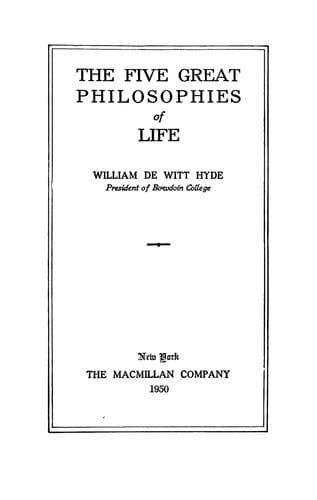
The Five Great Philosophies of LifeHyde, William De Witt
Philosophy
The Five Great Philosophies of Life
Hyde, William De Witt
Ethics; Philosophy, Ancient
If we rise above him, to serve higher ideals, conscious of the sacrifice
we make, and clear about the superior ends we gain thereby, then we may
be forgiven. What some of those higher ideals are we shall have occasion
to consider later. But to work ourselves into depression, disease, and
pain, for no better reason than to get high mark in some rank-book or
other, to gratify somebody's false vanity, to get together a little more
gold than we can spend wisely or our children can inherit without
enervation, to live in a bigger house than our neighbour has or we can
afford to take care of--to work for such ends as these beyond the point
where work is healthy and happy, is to commit a sin which neither
Epicurus nor Nature will forgive. With the people who have risen above
Epicurus, and are deliberately sacrificing to some extent the Epicurean
to one of the higher ideals, as I have said, we have no quarrel; for
them we have only hearty commendation. We do not ask the mother whose
child is dangerously sick, the statesman in a political crisis, the
artist when the conception of his great work comes over him, to heed for
the time being the limits of strength and the conditions of completest
health. All we ask of them is that later on, when the child has
recovered, when the crisis is past, when the picture is painted, they
shall reverently and humbly pay to Epicurus, or to Nature whom he
represents, the penalty for their sin, by a corresponding period of
complete rest and relaxation. We must bear strain at times; and Nature
will forgive us if we do not take it too often. But we must not bunch
our strains. We must not pass from one strain to another, and another,
without periods of relaxation between. We must not let the attitude of
strain become chronic, and develop into a moral tetanus, which keeps us
forever on the rack of exertion from sheer restless inability to sit
down and enjoy ourselves.
What we take from excessive work Epicurus would bid us add to needed
play. Play is an arrangement by which we get artificially, in highly
concentrated form, the pleasure which in ordinary life is diffused over
long periods, and attainable only in attenuated form. Play puts the
great fundamental pleasures of the race at the disposal of the
individual.
Public-domain text, read in full here on John Shaqi.
Reviews
Reviews
No reviews yet
Be the first to share your thoughts on this work.
Join the Discussion
Join the discussion
Sign in to leave a comment or review.
Sign InorCreate an account