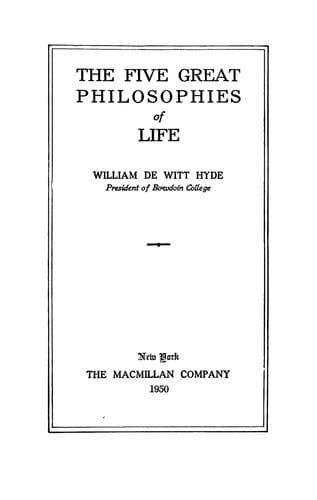
The Five Great Philosophies of LifeHyde, William De Witt
Philosophy
The Five Great Philosophies of Life
Hyde, William De Witt
Ethics; Philosophy, Ancient
The most uncompromising exponent of this second half of the Stoic
doctrine in the modern world is Immanuel Kant. According to him the
whole worth and dignity of life turns not on external fortune, nor even
on good natural endowments, but on our internal reaction, the reverence
of our will for universal law. "Nothing can possibly be conceived in the
world, or even out of it, which can be called good without
qualification, except a Good Will. Intelligence, wit, judgment, and the
other _talents_ of the mind, however they may be named, or courage,
resolution, perseverance, as qualities of temperament, are undoubtedly
good and desirable in many respects; but these gifts of nature may also
become extremely bad and mischievous if the will which is to make use of
them, and which, therefore, constitutes what is called character, is
not good. It is the same with the gifts of fortune. Power, riches,
honour, even health, and the general well-being and contentment with
one's condition which is called happiness, inspire pride and often
presumption, if there is not a good will to correct the influence of
these on the mind."
"Everything in nature works according to laws. Rational beings alone
have the faculty of acting according to the conception of laws, that is,
according to principles; _i.e._ have a will."
"Consequently the only good action is that which is done out of pure
reverence for universal law. This categorical imperative of duty is
expressed as follows: 'Act as if the maxim of thy action were to become
by thy will a Universal Law of Nature.' And since every other rational
being must conduct himself on the same rational principle that holds for
me, I am bound to respect him as I do myself. Hence the second practical
imperative is: 'So act as to treat humanity, whether in thine own person
or in that of any other, in every case as an end, never as means only.'"
In Kant Stoicism reaches its climax. Law and the will are everything:
possessions, even graces are nothing.
IV
THE STOIC SOLUTION OF THE PROBLEM OF EVIL
The problem of evil was the great problem of the Stoic, as the problem
of pleasure was the problem of the Epicurean. To this problem the Stoic
gives substantially four answers, with all of which we are already
somewhat familiar:--
First: Only that is evil which we choose to regard as such. To quote
Marcus Aurelius once more on this fundamental point: "Consider that
everything is opinion, and opinion is in thy power. Take away then, when
thou choosest, thy opinion, and like a mariner who has doubled the
promontory, thou wilt find calm, everything stable, and a waveless bay."
"Take away thy opinion, and then there is taken away the complaint: I
have been harmed. Take away the complaint: I have been harmed, and the
harm is done away."
Public-domain text, read in full here on John Shaqi.
Reviews
Reviews
No reviews yet
Be the first to share your thoughts on this work.
Elsewhere in the archive
Join the Discussion
Join the discussion
Sign in to leave a comment or review.
Sign InorCreate an account