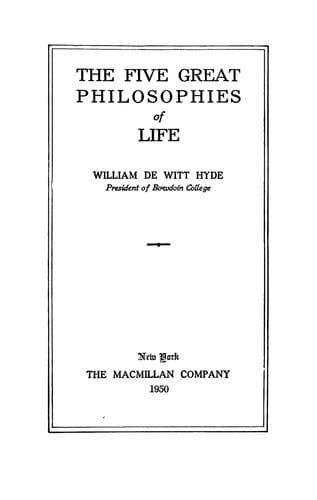
The Five Great Philosophies of LifeHyde, William De Witt
Philosophy
The Five Great Philosophies of Life
Hyde, William De Witt
Ethics; Philosophy, Ancient
"Beyond this place of wrath and tears
Looms but the Horror of the shade,
And yet the menace of the years
Finds, and shall find me unafraid.
"It matters not how strait the gate,
How charged with punishments the scroll,
I am the master of my fate:
I am the captain of my soul."
The chief modern type of Stoicism, however, is Matthew Arnold. His great
remedy for the ills of which life is so full is stated in the concluding
lines of "The Youth of Man":--
"While the locks are yet brown on thy head,
While the soul still looks through thine eyes,
While the heart still pours
The mantling blood to thy cheek,
Sink, O youth, in thy soul!
Yearn to the greatness of Nature;
Rally the good in the depths of thyself!"
VII
THE PERMANENT VALUE OF STOICISM
If now we know the two fundamental principles of Stoicism, the
indifference of external circumstance as compared with the reaction of
our own thought upon it, and the sanctification of our thought by
self-surrender to the universal law; and if we have learned to recognise
these Stoic notes alike in ancient and modern prose and poetry, we are
ready to discriminate between the good in it which we wish to cherish,
and the shortcomings of the system which it is well for us to avoid.
We can all reduce enormously our troubles and vexations by bringing to
bear upon them the two Stoic formulas. Toward material things, toward
impersonal events at least, we may all with profit put on the Stoic
armour, or to use the figure of the turtle, which is most expressive of
the Stoic attitude, we can all draw the soft sensitive flesh of our
feelings inside the hard shell of resolute thoughts. There is a way of
looking at our poverty, our plainness of feature, our lack of mental
brilliancy, our humble social estate, our unpopularity, our physical
ailments, which, instead of making us miserable, will make us modest,
contented, cheerful, serene. The mistakes that we make, the foolish
words we say, the unfortunate investments into which we get drawn, the
failures we experience, all may be transformed by the Stoic formula into
spurs to greater effort and stimulus to wiser deeds in days to come.
Simply to shift the emphasis from the dead external fact beyond our
control, to the live option which always presents itself within; and to
know that the circumstance that can make us miserable simply does not
exist, unless it exists by our consent within our own minds;--this is a
lesson well worth spending an hour with the Stoics to learn once for
all.
Public-domain text, read in full here on John Shaqi.
Reviews
Reviews
No reviews yet
Be the first to share your thoughts on this work.
Elsewhere in the archive
Join the Discussion
Join the discussion
Sign in to leave a comment or review.
Sign InorCreate an account