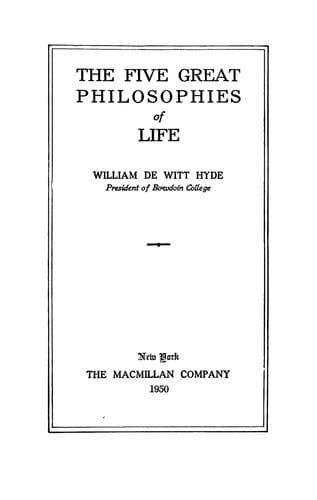
The Five Great Philosophies of LifeHyde, William De Witt
Philosophy
The Five Great Philosophies of Life
Hyde, William De Witt
Ethics; Philosophy, Ancient
And the other aspect of their doctrine, its quasi-religious side, though
not by any means the last word about religion, is a valuable first
lesson in the reality of religion. To know that the universal law is
everywhere, and that its will may in every circumstance be done; to
measure the petty perturbations of our little lives by the vast orbits
of natural forces moving according to beneficent and unchanging law;
when we come out of the exciting political meeting, or the roar of the
stock-exchange, to look up at the calm stars and the tranquil skies and
hear them say to us, "So hot, my little man";--this elevation of our
individual lives by the reverent contemplation of the universe and its
unswerving laws, is something which we may all learn with profit from
the old Stoic masters. Business, house-keeping, school-teaching,
professional life, politics, society, would all be more noble and
dignified if we could bring to them every now and then a touch of this
Stoic strength and calm.
Criticism, complaint, fault-finding, malicious scandal, unpopularity,
and all the shafts of the censorious are impotent to slay or even wound
the spirit of the Stoic. If these criticisms are true, they are welcomed
as aids in the discovery of faults which are to be frankly faced, and
strenuously overcome. If they are false, unfounded, due to the
querulousness or jealousy of the critic rather than to any fault of the
Stoic, then he feels only contempt for the criticisms and pity for the
poor misguided critic. The true Stoic can be the serene husband of a
scolding shrew of a wife; the complacent representative of dissatisfied
and enraged constituents; maintain unruffled equanimity when cut by his
aristocratic acquaintances and excluded from the most select social
circles: for he carries the only valid standard of social measurement
under his own hat, and needs not the adoration of his wife, the cheers
of his constituents, the cards and invitations, the nods and smiles of
the four hundred to assure him of his dignity and worth. If he is an
author, it does not trouble him that his books are unsold, unread,
uncut. If the many could appreciate him, he would have to be one of
themselves, and then there would be no use in his trying to instruct
them. His book is what the universal law gave him to say, and decreed
that it should be; and whether there be many or few to whom the
universal law has revealed the same truth, and granted power to
appreciate it, is the concern of the universal, not of himself, the
individual author. Again, if he is in poor health, weary, exhausted, if
each stroke of work must be wrought in agony and pain,--that, too, is
decreed for him by those just laws which he or his ancestors have
blindly violated; and he will accept even this dictate of the universal
law as just and good: he will not suffer these trifling incidental pains
and aches to diminish by one jot the output of his hand or brain. When
Public-domain text, read in full here on John Shaqi.
Reviews
Reviews
No reviews yet
Be the first to share your thoughts on this work.
Elsewhere in the archive
Join the Discussion
Join the discussion
Sign in to leave a comment or review.
Sign InorCreate an account