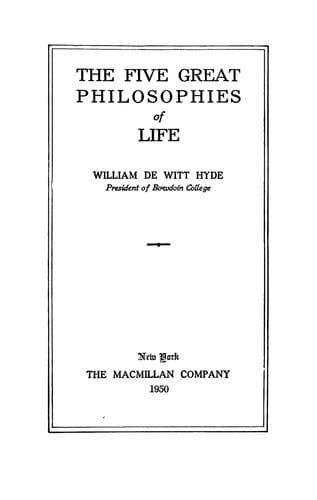
The Five Great Philosophies of LifeHyde, William De Witt
Philosophy
The Five Great Philosophies of Life
Hyde, William De Witt
Ethics; Philosophy, Ancient
"Riches according to nature are of limited extent, and can be easily
procured; but the wealth craved after by vain fancies knows neither end
nor limit. He who has understood the limits of life knows how easy it is
to get all that takes away the pain of want, and all that is required to
make our life perfect at every point. In this way he has no need of
anything which involves a contest." "The beginning and the greatest good
is prudence. Wherefore prudence is a more precious thing even than
philosophy: from it grow all the other virtues, for it teaches that we
cannot lead a life of pleasure which is not also a life of prudence,
honour, and justice; nor lead a life of prudence, honour, and justice,
which is not also a life of pleasure. For the virtues have grown into
one with a pleasant life, and a pleasant life is inseparable from them."
"Of all the things which wisdom procures for the happiness of life as a
whole, by far the greatest is the acquisition of friendship."
"We ought to look round for people to eat and drink with, before we look
for something to eat and drink: to feed without a friend is the life of
a lion and a wolf." "Do everything as if Epicurus had his eye upon you.
Retire into yourself chiefly at that time when you are compelled to be
in a crowd." "We ought to select some good man and keep him ever before
our eyes, so that we may, as it were, live under his eye, and do
everything in his sight." "No one loves another except for his own
interest." "Among the other ills which attend folly is this: it is
always beginning to live." "A foolish life is restless and disagreeable:
it is wholly engrossed with the future." "We are born once: twice we
cannot be born, and for everlasting we must be non-existent. But thou,
who art not master of the morrow, puttest off the right time.
Procrastination is the ruin of life for all; and, therefore, each of us
is hurried and unprepared at death." "Learn betimes to die, or if it
please thee better to pass over to the gods." "He who is least in need
of the morrow will meet the morrow most pleasantly." "Injustice is not
in itself a bad thing: but only in the fear, arising from anxiety on the
part of the wrong-doer, that he will not escape punishment." "A wise man
will not enter political life unless something extraordinary should
occur." "The free man will take his free laugh over those who are fain
to be reckoned in the list with Lycurgus and Solon."
Public-domain text, read in full here on John Shaqi.
Reviews
Reviews
No reviews yet
Be the first to share your thoughts on this work.
Join the Discussion
Join the discussion
Sign in to leave a comment or review.
Sign InorCreate an account