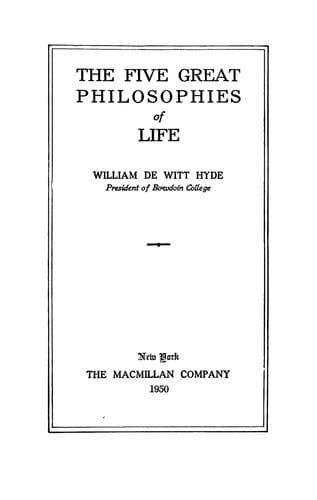
The Five Great Philosophies of LifeHyde, William De Witt
Philosophy
The Five Great Philosophies of Life
Hyde, William De Witt
Ethics; Philosophy, Ancient
What, then, in contrast to this would be a righteous state? It would be
a state in which each of these classes fulfils its part well, with a
view to the good of the whole. It would be a state where labour would be
organised into unions, which would not insist on having the greatest
possible wages for the least possible work, but which would maintain a
high standard of efficiency, and intelligence, and character in the
members, with a view to doing the best possible work in their trade, at
such wages as the resources and needs of the community, as indicated by
the normal action of demand and supply, would warrant. It would be a
state in which the capitalists would organise their business in such a
way that they might invite public inspection of the relation between the
capital, enterprise, skill, economy, and industry expended, and the
prices they charge for commodities furnished and services rendered. It
would be a state in which the police would maintain that order and law
which is the equal interest of the rich and poor alike. It would be a
state in which the men in political offices would use their official
positions and influence for the protection of the lives and promotion of
the interests of the whole people whom they represent and profess to
serve. It would be a state in which the colleges and universities would
be intensely alive to economic, social, and public questions, and devote
their learning to the maintenance of healthful material conditions, just
distribution of wealth, sound morals, and wise determination of public
policy.
Wherein, then, does the difference between an unrighteous and a
righteous state consist? Simply in this--that in the unrighteous state
each class in the community is playing for its own hand and regarding
the community as a mere means to its own selfish interests as the
supreme end,--while a righteous state on the contrary is one in which
each class in the community is doing its own work as economically and
efficiently as possible, with a view to the interests of the community
as a whole. In the unrighteous state the whole is subordinated to each
separate part; in the righteous state each part is subordinated to the
common interests of the whole. If, then, we ask as did Adeimantus in the
Republic, "Where, then, is righteousness, and in which particular part
of the state is it to be found," our answer will be that given by
Socrates, "that each individual man shall be put to that use for which
nature designs him, and every man will do his own business so that the
whole city will be not many but one." Righteousness, then, in the state
consists in having each class mind its own business with a view to the
good of the whole. On this, which is Plato's fundamental principle, we
can all agree.
Public-domain text, read in full here on John Shaqi.
Reviews
Reviews
No reviews yet
Be the first to share your thoughts on this work.
Elsewhere in the archive
Join the Discussion
Join the discussion
Sign in to leave a comment or review.
Sign InorCreate an account