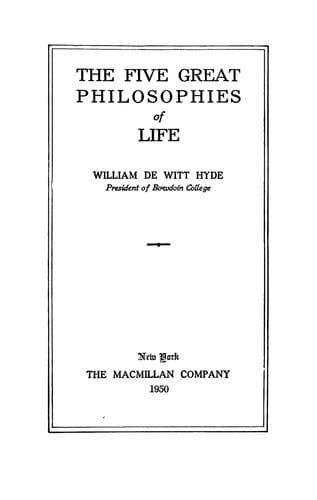
The Five Great Philosophies of LifeHyde, William De Witt
Philosophy
The Five Great Philosophies of Life
Hyde, William De Witt
Ethics; Philosophy, Ancient
Righteousness, however, is concerned with none of these considerations.
What makes one breakfast better than the other is the way it fits into
one's life as a whole. Which breakfast will enable you to do the best
forenoon's work? Which one will give you acute headache and chronic
dyspepsia? Immediate appetite cannot answer these questions. Reason is
the only one of our three departments that can tell us what is good for
the self as a whole. Now for most people in ordinary circumstances,
reason prescribes the second breakfast, or something like it. The second
breakfast fits into one's permanent plan of life. The work to be done in
the forenoon, the feelings one will have in the afternoon, the general
efficiency which we desire to maintain from day to day and year to year,
all point to the second breakfast as the more adapted to promote the
welfare of the self as a whole throughout the entire life history. If we
eat the first breakfast, appetite rules and reason is thrust into
subjection. The lower has conquered the higher; the part has domineered
the whole. To eat such a breakfast, for ninety-nine men out of every
hundred, would be gluttony. Yet, though eating it is vicious, the fault
is not in the breakfast, not in the hunger for it; but in the fact that
the appetite had its own way, regardless of the permanent interests of
the self as a whole; and that so far forth reason was dethroned, and
appetite set up as ruler in its place. Indeed there are circumstances in
which the first breakfast would be the right one to choose. If one were
on the borders of civilisation, setting out for a long tramp through the
wilderness, where every ounce of food must be carried on his back, and
no more fresh meat and home cooking could be expected for several days,
even reason herself might prescribe the first breakfast as more
beneficial to the whole man than the second. Precisely the same
breakfast which is good in one set of circumstances becomes bad in
another. The raw appetite of hunger is obviously neither good nor bad.
The rule of appetite over reason and the whole self, however, is bad
always, everywhere, and for everybody. It is in this rising up of the
lower part of the self against the higher, and its sacrifice of the self
as a whole to a particular gratification that all vice consists.
On the other hand, the rule of reason over appetite, the gratification
or the restraint of appetite according as the interests of the total
self require, is always and everywhere and for everybody good. This is
the essence of virtue; and the particular form of virtue that results
from this control of the appetites by reason in the interest of the
permanent and total self is temperance--the first and most fundamental
of Plato's cardinal virtues.
Public-domain text, read in full here on John Shaqi.
Reviews
Reviews
No reviews yet
Be the first to share your thoughts on this work.
Elsewhere in the archive
Join the Discussion
Join the discussion
Sign in to leave a comment or review.
Sign InorCreate an account