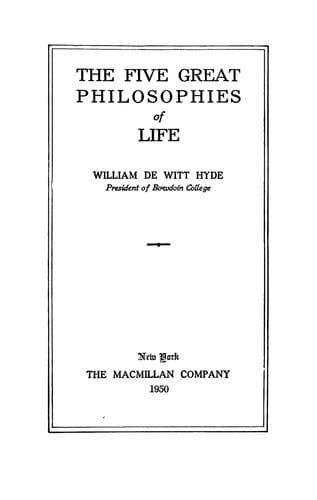
The Five Great Philosophies of LifeHyde, William De Witt
Philosophy
The Five Great Philosophies of Life
Hyde, William De Witt
Ethics; Philosophy, Ancient
The second element of human nature, spirit, must be dealt with in the
same way. By spirit Plato means the fighting element in us, that which
prompts us to defend ourselves, the faculty of indignation, anger, and
vengeance. To make it concrete, let us take a case. Suppose the cook in
our kitchen has times of being careless, cross, saucy, wilful, and
disobedient. The spirit within prompts us to upbraid her, quarrel with
her, and when she grows in turn more insolent and impertinent, to
discharge her. Is such an exercise of spirit a virtuous act? It may be
virtuous, or it may be vicious. In this element, considered in itself,
there is no more virtue or vice than in appetite considered in itself.
It is again a question of how this particular act of this particular
side of our nature stands related to the self as a whole. What does
reason say?
If I send this cook away, shall I be a long while without any; and after
much vexation probably put up with another not half so good? Will my
household be thrown into confusion? Will hospitality be made impossible?
Will the working power of the members of my household be impaired by
lack of well-prepared, promptly served food? In the present state of
this servant problem, all these things and worse are quite likely to
happen. Consequently reason declares in unmistakable terms that the
interests of the self as a whole demand the retention of the cook. But
it galls and frets our spirit to keep this impertinent, disobedient
servant, and hear her irritating words, and see her aggravating
behaviour. Never mind, reason says to the spirited element in us. The
spirit is not put into us in order that it may have a good time all by
itself on its own account. It is put into us to protect and promote the
interests of the self as a whole. You must bear patiently with the
incidental failings of your cook, and return soft answers to her harsh
words; because in that way you will best serve that whole self which
your spirit is given you to defend. In ninety-nine cases out of a
hundred a quarrel with a cook, on such grounds, in present conditions,
would be prejudicial to the interests of the self as a whole. It is the
sacrifice of the whole to the part; which as we saw in the case of
appetite is the essence of all vice. Only in this case the vice would
be, not intemperance, but cowardice, inability to bear a transient,
trifling pain patiently and bravely for the sake of the self as a whole.
Public-domain text, read in full here on John Shaqi.
Reviews
Reviews
No reviews yet
Be the first to share your thoughts on this work.
Elsewhere in the archive
Join the Discussion
Join the discussion
Sign in to leave a comment or review.
Sign InorCreate an account