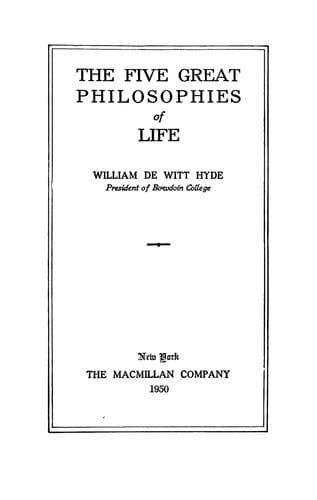
The Five Great Philosophies of LifeHyde, William De Witt
Philosophy
The Five Great Philosophies of Life
Hyde, William De Witt
Ethics; Philosophy, Ancient
Still, there might be aggravated cases in which the sharp reproof, the
quarrel, and the prompt discharge might be the brave and right thing to
do. If one felt it a contribution one was required to make to the whole
servant problem, and after considering all the inconvenience it would
cost, still felt that life as a whole was worth more with this
particular servant out of the house than in it, then precisely the same
act, which ordinarily would be wrong, in this exceptional case would be
right. It is not what you do, but how you do it, that determines whether
an outburst of anger is virtuous or vicious. If the whole self is in it,
if all interests have been fully weighed by the reason, if, in short,
you are all there when you do it, then the act is a virtuous act, and
the special name of this virtue of the spirit is courage or fortitude.
Anger and indignation going off on its own account is always vicious.
Anger and indignation properly controlled by reason in the interest of
the total self is always good. Precisely the same outward act done by
one man in one set of circumstances is bad, and shows the man to be
vicious, cowardly, and weak; while, if done by another man in other
circumstances, it shows him to be strong, brave, and manly. Virtue and
vice are questions of the subordination or insubordination of the lower
to the higher elements of our nature; of the parts of our selves to the
whole. The subordination of appetite to reason has given us the first of
the four virtues. The subordination of spirit to reason has given us
fortitude, the second.
Wisdom, the third of Plato's cardinal virtues, consists in the supremacy
of reason over spirit and appetite; just as temperance and courage
consisted in the subordination of appetite and spirit to reason. Wisdom,
then, is much the same thing as temperance and courage, only in more
positive and comprehensive form. Wisdom is the vision of the good, the
true end of man, for the sake of which the lower elements must be
subordinated. What, then, is the good, according to Plato? The good is
the principle of order, proportion, and harmony that binds the many
parts of an object into the effective unity of an organic whole. The
good of a watch is that perfect working together of all its springs and
wheels and hands, which makes it keep time. The good of a thing is the
thing's proper and distinctive function; and the condition of its
performing its function is the subordination of its parts to the
interest of the whole.
Public-domain text, read in full here on John Shaqi.
Reviews
Reviews
No reviews yet
Be the first to share your thoughts on this work.
Elsewhere in the archive
Join the Discussion
Join the discussion
Sign in to leave a comment or review.
Sign InorCreate an account