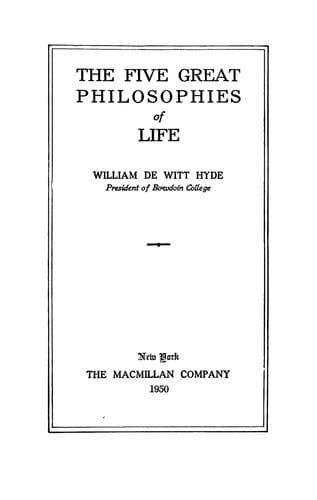
The Five Great Philosophies of LifeHyde, William De Witt
Philosophy
The Five Great Philosophies of Life
Hyde, William De Witt
Ethics; Philosophy, Ancient
At the age of twenty he would select the most promising youths and give
them a ten years' course in severe study of science. This systematic
study corresponds to the graduate and professional period in modern
education, only he extends it over ten years, where we confine it to
three or four. Again at thirty there is another selection of those who
are most steadfast in their learning and most faithful in their military
and public duties, and these are given a five years' course in dialectic
or philosophy. They are trained to see the relation of the special
sciences to each other and how each department of truth is related to
the whole. At the age of thirty-five they must be appointed to military
and other offices. "In this way they will get their experience of life,
and there will be an opportunity to try whether, when they are drawn all
manner of ways by temptation, they will stand firm or stir at all." And
when they have reached the age of fifty, after fifteen years of this
laboratory work in actual public service, holding subordinate offices
and learning to discriminate good and evil, not as we find them done up
in packages and labelled in the study, but as they are interwoven in the
complicated texture of real life, "those who still survive and have
distinguished themselves in every deed and in all knowledge, come at
last to their graduation; the time has now arrived at which they must
raise the eye of the soul to the universal light which lightens all
things and behold the absolute good; for that is the pattern according
to which they are to order the state and the lives of individuals and
the remainder of their own lives also, making philosophy their chief
pursuit; but when their turn comes, also toiling at politics and ruling
for the public good."
The wisdom which comes of this prolonged and elaborate education is the
third of Plato's four cardinal virtues. In the state it is the ruling
principle, and its agents are the philosophers. As Plato says in a
famous passage: "Until then philosophers are kings, or the kings and
princes of this world have the spirit and power of philosophy, and
political greatness and wisdom meet in one, and those commoner natures
who follow either to the exclusion of the other are compelled to stand
aside, cities will never cease from ill,--no, nor the human race, as I
believe,--and then only will this our state have a possibility of life
and behold the light of day." Precisely so, no individual will attain
his true estate until this philosophic principle, which sees the good,
through training has been so developed that it can bring both appetite
and spirit into subjection to it, as a charioteer controls his
headstrong horses.
V
RIGHTEOUSNESS THE COMPREHENSIVE VIRTUE
Public-domain text, read in full here on John Shaqi.
Reviews
Reviews
No reviews yet
Be the first to share your thoughts on this work.
Elsewhere in the archive
Join the Discussion
Join the discussion
Sign in to leave a comment or review.
Sign InorCreate an account