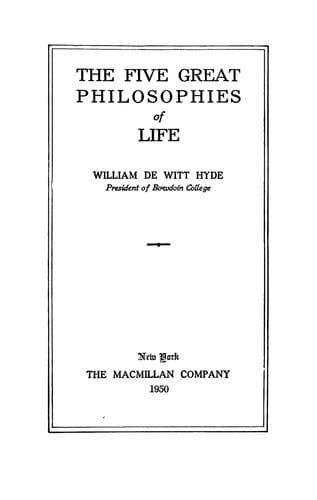
The Five Great Philosophies of LifeHyde, William De Witt
Philosophy
The Five Great Philosophies of Life
Hyde, William De Witt
Ethics; Philosophy, Ancient
We now have three of the cardinal virtues: temperance, the subjection of
appetite to reason; fortitude, the control of the spirit by reason; and
wisdom, won through education, the assertion of the dictates of reason
over the clamour of both appetite and spirit. But where, amid all this,
Plato asks, is righteousness? In reply he remarks, "that when we first
began our inquiry, ages ago, there lay righteousness rolling at our
feet, and we, fools that we were, failed to see her, like people who go
about looking for what they have in their hands. Righteousness is the
comprehensive aspect of the three virtues already considered in detail.
It is the ultimate cause and condition of the existence of all of them.
Righteousness in a state consists in each citizen doing the thing to
which his nature is most perfectly adapted: in minding one's own
business, in other words, with a view to the good of the whole.
Righteousness in an individual, then, consists in having each part of
one's nature devoted to its specific function: in having the appetites
obey, in having the spirit steadfast in difficulty and danger, and in
having the reason rule supreme. Thus righteousness, that subordination
and coordination of all the parts of the soul in the service of the soul
as a whole, includes each of the other three virtues and comprehends
them all in the unity of the soul's organic life.
"For the righteous man does not permit the several elements within him
to meddle with one another, but he sets in order his own inner life, and
is his own master, and at peace with himself; when he has bound
together the three principles within him, and is no longer many, but has
become one entirely temperate and perfectly adjusted nature, then he
will begin to act, if he has to act, whether in a matter of property, or
in the treatment of the body, or in some affairs of politics or of
private business; in all which cases he will think and call just and
good action, that which preserves and coöperates with this condition,
and the knowledge which presides over this wisdom."
Public-domain text, read in full here on John Shaqi.
Reviews
Reviews
No reviews yet
Be the first to share your thoughts on this work.
Elsewhere in the archive
Join the Discussion
Join the discussion
Sign in to leave a comment or review.
Sign InorCreate an account