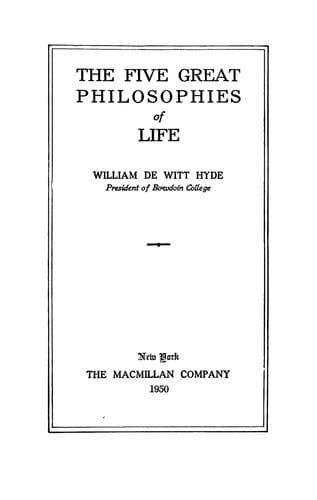
The Five Great Philosophies of LifeHyde, William De Witt
Philosophy
The Five Great Philosophies of Life
Hyde, William De Witt
Ethics; Philosophy, Ancient
The avaricious man is like the state which is governed by rich men. "Is
not this man likely to seat the concupiscent and covetous elements on
the vacant throne? And when he has made the reasoning and passionate
faculties sit on the ground obediently on either side, and taught them
to know their place, he compels the one to think only of the method by
which lesser sums may be converted into larger ones, and schools the
other into the worship and admiration of riches and rich men. Of all
conversions there is none so speedy or so sure as when the ambitious
youth changes into the avaricious one."
Nowhere is Plato more keen or more fair than in his judgment of the
money-maker. He says that he will generally do the right thing; he will
be eminently respectable; he will not sink to very low or disreputable
courses. All his goodness, however, will be of a forced, constrained,
artificial, and at bottom unreal character. He will be good because he
has to, in order to maintain that standing in the community on which his
wealth depends. In Plato's own words: "He coerces his bad passions by an
effort of virtue; not that he convinces them of evil, or exerts over
them the gentle influence of reason, but he acts upon them by necessity
and fear, and because he trembles for his possessions. This sort of man
will be at war with himself: he will be two men, not one; but, in
general, his better desires will be found to prevail over his inferior
ones. For these reasons such an one will be more decent than many are;
yet the true virtue of a unanimous and harmonious soul will be far out
of his reach."
The next step down for the state is what Plato calls democracy. Of the
democracy of intelligence and self-control diffused throughout the body
of self-respecting citizens Plato had formed and could form no
conception. By democracy he meant the state of things where each man
does that which is right in his own eyes. "In the first place the
citizens are free. The city is full of freedom and frankness--there a
man may do as he likes. They have a complete assortment of
constitutions; and if a man has a mind to establish a state, he must go
to a democracy as he would go to a bazaar, where they sell them, and
pick out one that suits him. Democracy is a most accommodating and
charming form of government, full of variety and diversity, and (this,
perhaps, is the keenest of all Plato's keen thrusts) _dispensing
equality to equals and unequals alike_."
Public-domain text, read in full here on John Shaqi.
Reviews
Reviews
No reviews yet
Be the first to share your thoughts on this work.
Elsewhere in the archive
Join the Discussion
Join the discussion
Sign in to leave a comment or review.
Sign InorCreate an account