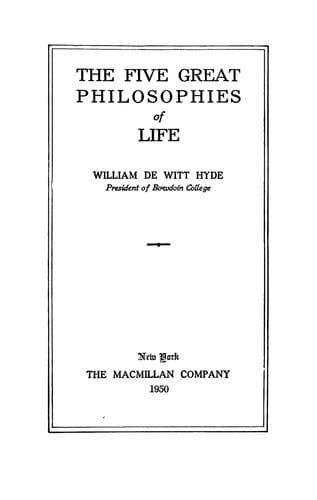
The Five Great Philosophies of LifeHyde, William De Witt
Philosophy
The Five Great Philosophies of Life
Hyde, William De Witt
Ethics; Philosophy, Ancient
The man corresponding to democracy in the state, is the man whose life
is given over to the undiscriminating enjoyment of all sorts of
pleasures. "In this way the young man passes out of his original nature
which was trained in the school of necessity, into the freedom and
libertinism of useless and unnecessary pleasures, putting the government
of himself into the hands of the one of his pleasures that offers and
wins the turn; and when he has had enough of that, then into the hands
of another, and is very impartial in his encouragement of them all.
Neither does he receive or admit into the fortress any true word of
advice; if any one says to him that some pleasures are the satisfactions
of good and noble desires, and others of evil desires, and that he
ought to use and honour some and curtail and reduce others--whenever
this is repeated to him he shakes his head and says that they are all
alike, and that one is as honourable as another. He lives through the
day, indulging the appetite of the hour; and sometimes he is lapped in
drink and strains of the flute; then he is for total abstinence, and
tries to get thin; then again, he is at gymnastics; sometimes idling and
neglecting everything, then once more living the life of a philosopher;
often he is at politics, and starts to his feet and says and does
anything that may turn up; and, if he is emulous of any one who is a
warrior, off he is in that direction, or of men of business, once more
in that. His life has neither order nor law; and this is the way of
him,--this he terms joy and freedom and happiness. There is liberty,
equality, and fraternity enough in him."
The life of chance desire, unregulated by any subordinating principle,
then, is the third stage of the descent and degradation of the soul.
Public-domain text, read in full here on John Shaqi.
Reviews
Reviews
No reviews yet
Be the first to share your thoughts on this work.
Elsewhere in the archive
Join the Discussion
Join the discussion
Sign in to leave a comment or review.
Sign InorCreate an account