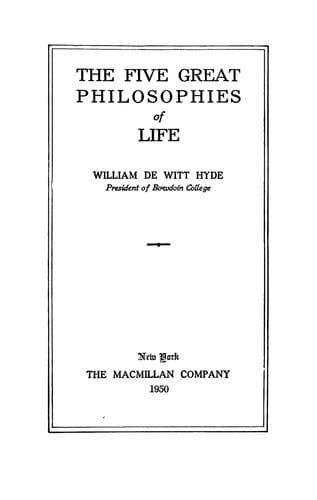
The Five Great Philosophies of LifeHyde, William De Witt
Philosophy
The Five Great Philosophies of Life
Hyde, William De Witt
Ethics; Philosophy, Ancient
In the state democracy speedily and inevitably passes over into tyranny.
All appetite is insatiable. In a state where each citizen does what he
pleases "all things are just ready to burst with liberty; excess of
liberty, whether in states or individuals, seems only to pass into
excess of slavery. Then tyranny naturally arises out of democracy." He
then proceeds, with prophetic pen, to trace the evolution of the modern
political boss. First there develops a class of drones who get their
living as professional politicians. Second, "there is the richest class,
which, in a nation of traders, is generally the most orderly; they are
the most squeezable persons and yield the largest amount of honey to the
drones; this is called the wealthy class, and the drones feed upon them.
There is also a third class, consisting of working-men who are not
politicians and have little to live upon; these, when assembled, are the
largest and most powerful class in a democracy; but then, the multitude
is seldom willing to meet unless they get a little honey. Their leaders
take the estates of the rich and give to the people as much of them as
they can consistently with keeping the greater part themselves. The
people have always some one as a champion whom they raise into
greatness. This is the very root from which a tyrant (that is, as we
should say, a boss) comes. When he first appears above ground, he is a
protector. At first, in the early days of his power, he smiles upon
every one and salutes every one; he, to be called a tyrant who is making
promises in public and also in private, and wanting to be kind and good
to every one! Thus liberty, getting out of all order and reason, passes
into the harshest and bitterest form of slavery." The worst form of
government, according to Plato, is that which we know too well to-day in
our great cities: the government of the professional politician who
maintains himself by buying the votes of the poor with the money he has
squeezed out of the rich. All pretence of administering the government
in the interest of the community is frankly abandoned. The boss, or
tyrant, as Plato calls him, frankly and unblushingly avows that he is in
politics for what he can get out of it.
Public-domain text, read in full here on John Shaqi.
Reviews
Reviews
No reviews yet
Be the first to share your thoughts on this work.
Elsewhere in the archive
Join the Discussion
Join the discussion
Sign in to leave a comment or review.
Sign InorCreate an account