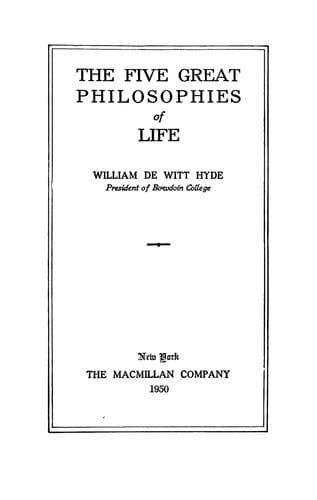
The Five Great Philosophies of LifeHyde, William De Witt
Philosophy
The Five Great Philosophies of Life
Hyde, William De Witt
Ethics; Philosophy, Ancient
Obviously this Platonic principle is vastly deeper and truer than
anything we have had before. The personality at which both Stoic and
Epicurean aimed was highly abstract,--something to be gained by getting
away from the tangle and complexity of life rather than by conquering
and transforming the conditions of existence into expressions of
ourselves. Epicurus makes a few sallies from his cosey comfortable camp,
to forage for provender. The Stoic draws into the citadel of his own
self-sufficiency; and from this fortified position defies attack. Plato
comes out into the open field, and squarely gives battle to the hosts
of appetite, passion, temptation, and corruption, of which the world
outside, and our hearts inside are full. In this he is true to the moral
experience of the race: and his trumpet-call to the higher departments
of our nature to enter the "great combat of righteousness"; his demand
of instantaneous and absolute surrender which he presents to everything
low and sensual within us, are clear, strong notes which it is good for
every one of us to hear and heed. To him as to Carlyle, "Life is not a
May-game, but a battle and a march, a warfare with principalities and
powers. No idle promenade through fragrant orange-groves and green
flowery spaces waited on by the choral muses and the rosy hours; it is a
stern pilgrimage through the rough, burning sandy solitudes, through
regions of thick-ribbed ice. He walks among men, loves men with
inexpressible soft pity, as they _cannot_ love him; but his soul dwells
in solitude, in the uttermost parts of creation. All Heaven, all
Pandemonium are his escort. The stars, keen glancing, from the
immensities, send tidings to him; the graves, silent with their dead,
from the eternities. Deep calls for him unto deep.
"Thou, O World, how wilt thou secure thyself against this man? None of
thy promotions is necessary for him. His place is with the stars of
Heaven; to thee it may be momentous, to thee it may be life or death; to
him it is indifferent, whether thou place him in the lowest hut, or
forty feet higher at the top of thy stupendous high tower, while here on
Earth. He wants none of thy rewards; behold also he fears none of thy
penalties. Thou canst not hire him by thy guineas; nor by thy gibbets
and law-penalties restrain him. Thou canst not forward him; thou canst
not hinder him. Thy penalties, thy poverties, neglects,
contumelies,--behold all these are good for him. To this man death is
not a bugbear; to this man life is already as earnest and awful, and
beautiful and terrible as death."
Public-domain text, read in full here on John Shaqi.
Reviews
Reviews
No reviews yet
Be the first to share your thoughts on this work.
Elsewhere in the archive
Join the Discussion
Join the discussion
Sign in to leave a comment or review.
Sign InorCreate an account