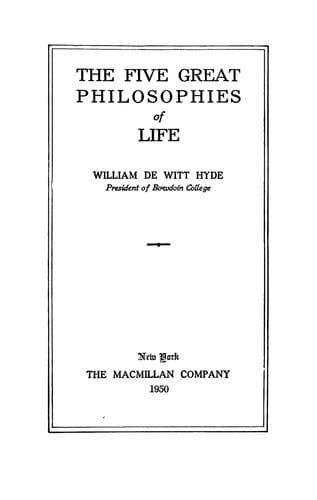
The Five Great Philosophies of LifeHyde, William De Witt
Philosophy
The Five Great Philosophies of Life
Hyde, William De Witt
Ethics; Philosophy, Ancient
This is a note which appeals forcibly to every noble youth. It has been
struck by the Hebrew Prophets and the Christian Apostles: by Savonarola
and Fichte, and a host of heroic souls; but by no one more clearly and
constrainingly than by Plato. It is the note of earnest and aggressive
righteousness; without which no personality can be either sound or
strong. The man who has never heard this summons to go forth and conquer
the evils of the world without and of his own heart within him, in the
name of a righteousness high above both his own attainment and the
attainment of the world about him as the heavens are higher than the
earth, is still in the nursery stage of personal development.
On the other hand, there is danger in the very sharpness of the
antithesis which Platonism makes between the higher and the lower. For
the most part this danger is latent in Plato himself; though even in him
it came out in his tendency to regard family life and private property
as detrimental rather than serviceable to that development of character
on which the larger devotion to the state, and the ideal order, must
ultimately rest.
In Neoplatonism, in the many forms of mysticism, in certain aspects of
Christian asceticism, and notably in the numerous phases of what calls
itself "New Thought" to-day, what was for the most part latent in Plato,
becomes frankly explicit. In general it is a loosening of the ties that
hold us to drudgery and homely duty; a weakening of the bonds that bind
us to the men and women by our side, in order to gaze more serenely on
the ineffable beyond the clouds. This developed Platonism admits that we
must live after a fashion in this very imperfect world; but says our
real conversation all the time must be in heaven. Individual people are
but faulty, imperfect copies of the pattern of the perfect good laid up
on high. We must buy and sell, work and play, laugh and cry, love and
hate down here among the shadows; but we must all the time feed our
souls on the good, the true, the beautiful, which these distorted human
shadows only serve to hide. These Platonic lovers of something better
than their husbands or wives, or associates or friends, go through the
world with a serene smile, and an air of other-worldliness which, if we
do not inquire too closely into their domestic life and business
efficiency, we cannot but admire. They undoubtedly exert a
tranquillising influence in their way, especially on those who are so
fortunate as to behold them from a little distance. But they are not the
most comfortable people to live with, as husband or wife, colleague or
business partner. Louisa Alcott had this Platonic type in mind when she
defined a philosopher as a man up in a balloon, with his family and
friends having hold of the ropes, trying to pull him down to earth.
Public-domain text, read in full here on John Shaqi.
Reviews
Reviews
No reviews yet
Be the first to share your thoughts on this work.
Elsewhere in the archive
Join the Discussion
Join the discussion
Sign in to leave a comment or review.
Sign InorCreate an account