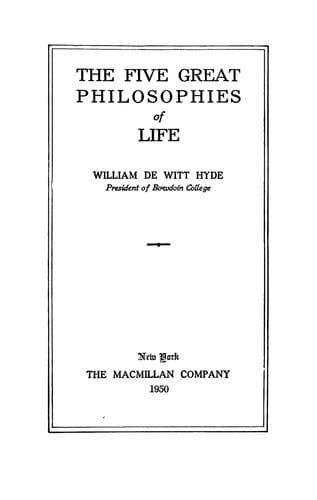
The Five Great Philosophies of LifeHyde, William De Witt
Philosophy
The Five Great Philosophies of Life
Hyde, William De Witt
Ethics; Philosophy, Ancient
seeking to confirm. Aristotle lays it down as an axiom, that a man who
does not devote himself to some section of the social and spiritual
world, if such a being were conceivable, would be no man at all. Family,
or friends, or reputation, or country, or God are there in the
background, secretly summoned to justify our every thought and word and
deed.
Because man's nature is social, his end must be social also. It will
prevent misunderstanding later, if we put the question squarely here,
Does the end justify the means? As popularly understood, most
emphatically No. The support of a school is a good end. Does it justify
the raising of money by a lottery? Certainly not. The support of one's
family is a good end. Does it justify drawing a salary for which no
adequate services are rendered? Certainly not.
Yet if we push the question farther, and ask why these particular ends
do not justify these particular means, we discover that it is because
these means employed are destructive of an end vastly higher and greater
than the particular ends they are employed to serve. They break down the
structure and undermine the foundations of the industrial and social
order; an end infinitely more important than the maintenance of any
particular school, or the support of any individual family. Hence these
means are not to be judged by their promotion of certain specific ends,
but by their failure to promote the greatest and best end of all; the
comprehensive welfare of society as a whole, of which all institutions
and families and individuals are but subordinate members.
Throughout our discussion of Aristotle we must understand that the word
"end" always has this large social reference, and includes the highest
social service of which the man is capable. If we attempt to apply to
particular private ends of our own what Aristotle applies to the
universal end at which all men ought to aim, we shall make his teaching
a pretext for the grossest crimes, and reduce it to little more than
sophisticated selfishness. With this understanding of his terms, we may
venture to plunge boldly into his system and state it in its most
paradoxical and startling form.
III
RIGHT AND WRONG DETERMINED BY THE END
Public-domain text, read in full here on John Shaqi.
Reviews
Reviews
No reviews yet
Be the first to share your thoughts on this work.
Elsewhere in the archive
Join the Discussion
Join the discussion
Sign in to leave a comment or review.
Sign InorCreate an account