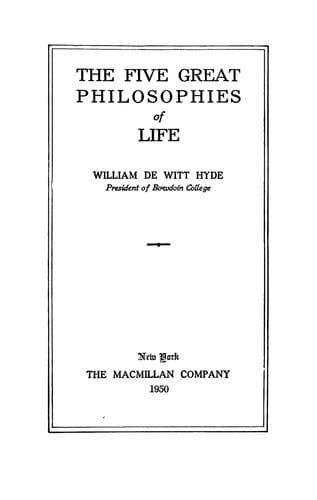
The Five Great Philosophies of LifeHyde, William De Witt
Philosophy
The Five Great Philosophies of Life
Hyde, William De Witt
Ethics; Philosophy, Ancient
We are not either good or bad at the start. Pleasure in itself is
neither good nor bad. Laws in themselves are neither good nor bad. It is
impossible to say with Plato that some faculties are so high that they
always ought to be exercised, and others are so low that as a rule they
ought to be suppressed. The right and wrong of eating and drinking, of
work and play, of sex and society, of property and politics, lie not in
the elemental acts involved. All of these things are right for one man
in one set of circumstances, wrong for another man in another set of
circumstances. We cannot say that a man who takes a vow of poverty is
either a better or a worse man than a multi-millionnaire. We cannot say
that the monk who takes a vow of celibacy is a purer man than one who
does not. For the very fact that one is compelled to take a vow of
poverty or celibacy is a sign that these elemental impulses are not
effectively and satisfactorily related to the normal ends they are
naturally intended to subserve. All attempts to put virginity above
motherhood, to put poverty above riches, to put obscurity above fame
are, from the Aristotelian point of view, essentially immoral. For they
all assume that there can be badness in external things, wrong in
isolated actions, vice in elemental appetites, and sin in natural
passions; whereas Aristotle lays down the fundamental principle that the
only place where either badness or wrong or vice or sin can reside is in
the relation in which these external things and particular actions
stand to the clearly conceived and deliberately cherished end which the
man is seeking to promote. A simpler way of saying the same thing, but a
way so simple and familiar as to be in danger of missing the whole
point, is to say that virtue and vice reside exclusively in the wills of
free agents. That, every one will admit. But will is the pursuit of
ends. A will that seeks no ends is a will that wills nothing; in other
words, no will at all. Whether an act is wrong or right, then, depends
on the whole plan of life of which it is a part; on the relation in
which it stands to one's permanent interests. For these many years I
have defied class after class of college students to bring in a single
example of any elemental appetite or passion which is intrinsically bad;
which in all circumstances and relations is evil. And never yet has any
student brought me one such case. If brandy will tide the weak heart
over the crisis that follows a surgical operation, then that glass of
brandy is just as good and precious as the dear life it saves. The
proposition that sexual love is intrinsically evil, and those who take
vows of celibacy are intrinsically superior, is true only on condition
that racial suicide is the greatest good, and all the sweet ties of
home and family and parenthood and brotherly love are evils which it is
our duty to combat. To deny that wealth is good is only possible to him
Public-domain text, read in full here on John Shaqi.
Reviews
Reviews
No reviews yet
Be the first to share your thoughts on this work.
Elsewhere in the archive
Join the Discussion
Join the discussion
Sign in to leave a comment or review.
Sign InorCreate an account