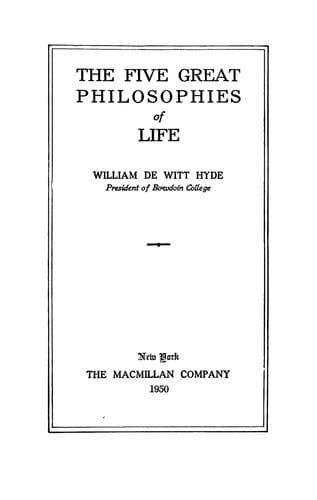
The Five Great Philosophies of LifeHyde, William De Witt
Philosophy
The Five Great Philosophies of Life
Hyde, William De Witt
Ethics; Philosophy, Ancient
Two men seek political office. For one man it is the gate of heaven; to
the other it is the door to hell. One man has established himself in a
business or profession in which he can earn an honest living and support
his family. He has acquired sufficient standing in his business so that
he can turn it over temporarily to his partners or subordinates. He has
solved his own problem; and he has strength, time, energy, capacity,
money, which he can give to solving the problems of the public. Were he
to shirk public office, or evade it, or fail to take all legitimate
means to secure it, he would be a coward, a traitor, a parasite on the
body politic. For there is good work to be done, which he is able to do,
and can afford to do, without unreasonable sacrifice of himself or his
family. Hence public office is for this man the gateway of heaven.
The other man has not mastered any business or profession; he has not
made himself indispensable to any employer or firm; he has no permanent
means of supporting himself and his family. He sees a political office
in which he can get a little more salary for doing a good deal less work
than is possible in his present position. He seeks the office, as a
means of getting his living out of the public. From that day forth he
joins the horde of mere office-seekers, aiming to get out of the public
a living he is too lazy, or too incompetent, or too proud to earn in
private employment. Thus the very same external act, which was the
other man's strait, narrow gateway to heaven, is for this man the broad,
easy descent into hell.
Two women join the same woman's club, and take part in the same
programme. One of them has her heart in her home; has fulfilled all the
sweet charities of daughter, sister, wife, or mother; and in order to
bring back to these loved ones at home wider interests, larger
friendships, and a richer and more varied interest in life, has gone out
into the work and life of the club. No angel in heaven is better
employed than she in the preparation and delivery of her papers and her
attendance on committee meetings and afternoon teas.
The other woman finds home life dull and monotonous. She likes to get
away from her children. She craves excitement, flattery, fame, social
importance. She is restless, irritable, out of sorts, censorious,
complaining at home; animated, gracious, affable, complaisant abroad.
For drudgery and duty she has no strength, taste, or talent; and the
thought of these things are enough to give her dyspepsia, insomnia, and
nervous prostration. But for all sorts of public functions, for the
preparation of reports, and the organisation of new charitable and
philanthropic and social schemes, she has all the energy of a
steam-engine, the power of a dynamo. When this woman joins a new club,
or writes a new paper, or gets a new office, though she does not a
single thing more than her angel sister who sits by her side, she is
playing the part of a devil.
Public-domain text, read in full here on John Shaqi.
Reviews
Reviews
No reviews yet
Be the first to share your thoughts on this work.
Elsewhere in the archive
Join the Discussion
Join the discussion
Sign in to leave a comment or review.
Sign InorCreate an account