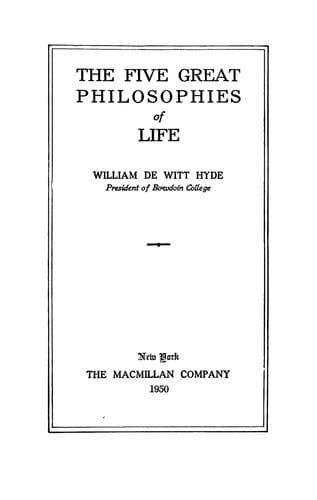
The Five Great Philosophies of LifeHyde, William De Witt
Philosophy
The Five Great Philosophies of Life
Hyde, William De Witt
Ethics; Philosophy, Ancient
It is not what one does; it is the whole purpose of life consciously or
unconsciously expressed in the doing that measures the worth of the man
or woman who does it. At the family table, at the bench in the shop, at
the desk in the office, in the seats at the theatre, in the ranks of the
army, in the pews of the church, saint and sinner sit side by side; and
often the keenest outward observer cannot detect the slightest
difference in the particular things that they do. The good man is he
who, in each act he does or refrains from doing, is seeking the good of
all the persons who are affected by his action. The bad man is the man
who, whatever he does or refrains from doing, leaves out of account the
interests of some of the people whom his action is sure to affect. Is
there any sphere of human welfare to which you are indifferent? Are
there any people in the world whose interests you deliberately
disregard? Then, no matter how many acts of charity and philanthropy,
and industry and public spirit you perform--acts which would be good if
a good man did them--in spite of them all, you are to that extent an
evil man.
We have, then, clearly in mind Aristotle's first great concept. The end
of life, which he calls happiness, he defines as the identification of
one's self with some large social or intellectual object, and the
devotion of all one's powers to its disinterested service. So far forth
it is Carlyle's gospel of the blessedness of work in a worthy cause.
"Blessed is he who has found his work; let him ask no other blessedness.
He has a work, a life purpose; he has found it, and will follow it. The
only happiness a brave man ever troubled himself with asking much about
was happiness enough to get his work done. Whatsoever of morality and of
intelligence; what of patience, perseverance, faithfulness of method,
insight, ingenuity, energy; in a word, whatsoever of strength the man
had in him will lie written in the work he does. To work: why, it is to
try himself against Nature and her everlasting unerring laws; these will
tell a true verdict as to the man."
Public-domain text, read in full here on John Shaqi.
Reviews
Reviews
No reviews yet
Be the first to share your thoughts on this work.
Elsewhere in the archive
Join the Discussion
Join the discussion
Sign in to leave a comment or review.
Sign InorCreate an account