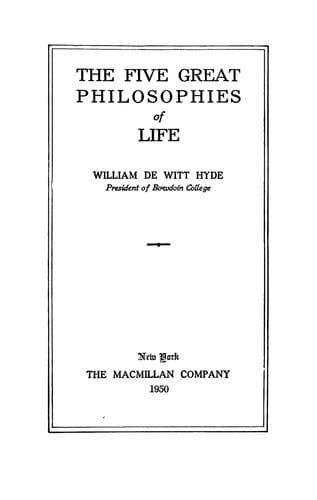
The Five Great Philosophies of LifeHyde, William De Witt
Philosophy
The Five Great Philosophies of Life
Hyde, William De Witt
Ethics; Philosophy, Ancient
When we read Carlyle, we are apt to think such words merely exaggerated
rhetoric. Now Aristotle says the same thing in the cold, calculated
terms of precise philosophy. A man is what he does. He can do nothing
except what he first sees as an unaccomplished idea, and then bends all
his energies to accomplish. In working out his ideas and making them
real, he at the same time works out his own powers, and becomes a living
force, a working will in the world. And since the soul is just this
working will, the man has so much soul, no more, no less, than he
registers in manual or mental work performed. To be able to point to
some sphere of external reality, a bushel of corn, a web of cloth, a
printed page, a healthful tenement, an educated youth, a moral
community, and say that these things would not have been there in the
outward world, if they had not first been in your mind as an idea
controlling your thought and action;--this is to point to the external
and visible counterpart and measure of the invisible and internal energy
which is your life, your soul, your self, your personality.
IV
THE NEED OF INSTRUMENTS
Aristotle's first doctrine, then, is that we must work for worthy ends.
The second follows directly from it. We must have tools to work with;
means by which to gain our ends. General Gordon, who was something of a
Platonist, remarked to Cecil Rhodes, who was a good deal of an
Aristotelian, that he once had a whole room full of gold offered him,
and declined to take it. "I should have taken it," replied Mr. Rhodes.
"What is the use of having great schemes if you haven't the means to
carry them out?" As Aristotle says: "Happiness plainly requires external
goods; for it is impossible, or at least not easy, to act nobly without
some furniture of fortune. There are many things that can be done only
through instruments, so to speak, such as friends and wealth and
political influence; and there are some things whose absence takes the
bloom off our happiness, as good birth, the blessing of children,
personal beauty. Happiness, then, seems to stand in need of this kind of
prosperity."
How different this from all our previous teachings! The Epicurean wants
little wealth, no family, no official station; because all these things
involve so much care and bother. The Stoic barely tolerates them as
indifferent. Plato took especial pains to deprive his guardians of most
of these very things. Aristotle on this point is perfectly sane. He says
you want them; because, to the fullest life and the largest work, they
are well-nigh indispensable. The editor of a metropolitan newspaper, the
president of a railroad, the corporation attorney cannot live their
lives and do their work effectively without comfortable homes, enjoyable
vacations, social connections, educational opportunities, which cost a
great deal of money. For them to despise money would be to despise the
conditions of their own effective living, to pour contempt on their own
souls.
Public-domain text, read in full here on John Shaqi.
Reviews
Reviews
No reviews yet
Be the first to share your thoughts on this work.
Elsewhere in the archive
Join the Discussion
Join the discussion
Sign in to leave a comment or review.
Sign InorCreate an account