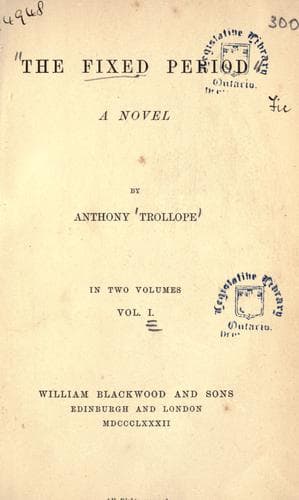
Australia -- Fiction; Fantasy fiction; Killing of the elderly -- Fiction
The Fixed Period has been so far discussed as to make it almost
unnecessary for me to explain its tenets, though its advantages may
require a few words of argument in a world that is at present dead to
its charms. It consists altogether of the abolition of the miseries,
weakness, and _faineant_ imbecility of old age, by the prearranged
ceasing to live of those who would otherwise become old. Need I
explain to the inhabitants of England, for whom I chiefly write, how
extreme are those sufferings, and how great the costliness of that
old age which is unable in any degree to supply its own wants? Such
old age should not, we Britannulists maintain, be allowed to be. This
should be prevented, in the interests both of the young and of those
who do become old when obliged to linger on after their "period" of
work is over. Two mistakes have been made by mankind in reference to
their own race,--first, in allowing the world to be burdened with the
continued maintenance of those whose cares should have been made to
cease, and whose troubles should be at an end. Does not the Psalmist
say the same?--"If by reason of strength they be fourscore years, yet
is their strength labour and sorrow." And the second, in requiring
those who remain to live a useless and painful life. Both these
errors have come from an ill-judged and a thoughtless tenderness,--a
tenderness to the young in not calling upon them to provide for
the decent and comfortable departure of their progenitors; and a
tenderness to the old lest the man, when uninstructed and unconscious
of good and evil, should be unwilling to leave the world for which
he is not fitted. But such tenderness is no better than unpardonable
weakness. Statistics have told us that the sufficient sustenance of
an old man is more costly than the feeding of a young one,--as is
also the care, nourishment, and education of the as yet unprofitable
child. Statistics also have told us that the unprofitable young and
the no less unprofitable old form a third of the population. Let the
reader think of the burden with which the labour of the world is thus
saddled. To these are to be added all who, because of illness cannot
work, and because of idleness will not. How are a people to thrive
when so weighted? And for what good? As for the children, they are
clearly necessary. They have to be nourished in order that they may
do good work as their time shall come. But for whose good are the old
and effete to be maintained amid all these troubles and miseries? Had
there been any one in our Parliament capable of showing that they
could reasonably desire it, the bill would not have been passed.
Though to me the politico-economical view of the subject was always
very strong, the relief to be brought to the aged was the one
argument to which no reply could be given.
Public-domain text, read in full here on John Shaqi.
Reviews
Reviews
No reviews yet
Be the first to share your thoughts on this work.
Join the Discussion
Join the discussion
Sign in to leave a comment or review.
Sign InorCreate an account