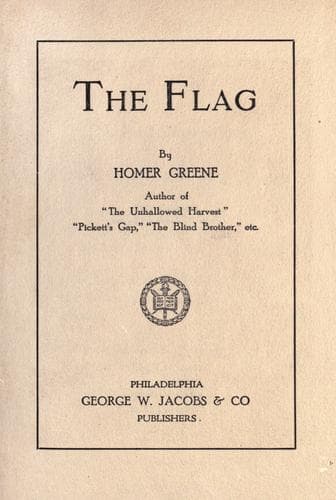
Patriotism -- Juvenile fiction; World War, 1914-1918 -- Juvenile fiction
Then the old man, round-faced and rosy, with a fringe of gray whiskers
under his chin, and a green and red comforter about his neck, reached
out a mittened hand and shook hands with Pen.
"Couldn't keep her to hum," he said, "when she seen me hitchin' up old
Charlie."
He laughed good-naturedly and tucked the buffalo-robe in under him.
"How's grandma?" asked Pen.
"Jest about as usual," was the reply. "When you comin' out to see us?"
"I don't know. Maybe a week from Saturday. I'll see."
Then Pen's mother spoke again.
"You were going to school, weren't you? We won't keep you. Give my
love to Aunt Millicent; and come soon to see us."
She kissed him again; the old man clicked to his horse, and succeeded,
after some effort, in starting him, and Pen returned to the sidewalk
and resumed his journey toward school.
It was noticeable that no one had spoken of Colonel Butler, the
grandfather with whom Pen lived at Bannerhall on the main street of
Chestnut Hill. There was a reason for that. Colonel Butler was Pen's
paternal grandfather; and Colonel Butler's son had married contrary to
his father's wish. When, a few years later, the son died, leaving a
widow and an only child, Penfield, the colonel had so far relented as
to offer a home to his grandson, and to provide an annuity for the
widow. She declined the annuity for herself, but accepted the offer of
a home for her son. She knew that it would be a home where, in charge
of his aunt Millicent, her boy would receive every advantage of care,
education and culture. So she kissed him good-by and left him there,
and she herself, ill, penniless and wretched, went back to live with
her father on the little farm at Cobb's Corners, five miles away. But
all that was ten years before, and Pen was now fourteen. That he had
been well cared for was manifest in his clothing, his countenance,
his bearing and his whole demeanor as he hurried along the partly
swept pavement toward his destination.
A few blocks farther on he overtook a school-fellow, and, as they
walked together, they discussed the war.
For war had been declared. It had not only been declared, it was in
actual progress.
Equipped and generalled, stubborn and aggressive, the opposing forces
had faced each other for weeks. Yet it had not been a sanguinary
conflict. Aside from a few bruised shins and torn coats and missing
caps, there had been no casualties worth mentioning. It was not a
country-wide war. It was, indeed, a war of which no history save this
veracious chronicle, gives any record.
Public-domain text, read in full here on John Shaqi.
Reviews
Reviews
No reviews yet
Be the first to share your thoughts on this work.
Join the Discussion
Join the discussion
Sign in to leave a comment or review.
Sign InorCreate an account