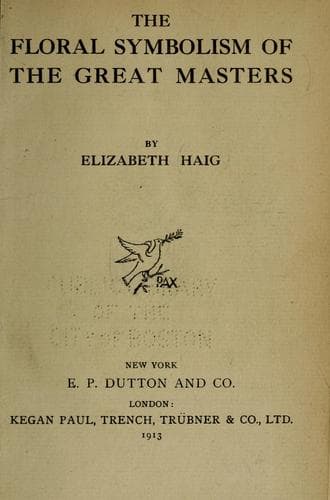
The floral symbolism of the great mastersHaig, Elizabeth
Religion
The floral symbolism of the great masters
Haig, Elizabeth
Flowers -- Symbolic aspects
The Northern symbolists, also, took clustering grapes to have the same
value as the Eucharistic wine as an emblem of Christ’s blood. This is
clearly seen in a tapestry of the fourteenth century, formerly in the
Spitzer Collection. The Infant Christ, seated between the Virgin and
Saint Joseph, presses with His hands the juice of a bunch of purple
grapes into a chalice.
Another Flemish tapestry of the same period, which was also in the same
collection, depicts the Holy Family with Saint Anne. Mary, from whom
the Saviour received His human blood, hands to her Son the grapes which
He crushes till the wine drops down into the cup.
But the cluster of grapes which several of the Flemish artists place in
the hand of the Infant Christ seems to be not only the emblem of the
holy blood, but also, in some sort, the antithesis of the apple as the
fruit of redemption, which in the hand of the second Adam replaces the
fruit of the Fall.
In a picture by Mabuse, inscribed ‘Verus Deus et Homo: casta mater et
Virgo,’[302] the Virgin offers a bunch of grapes to the Infant Christ,
who holds a quince, foreshadowing that He should exchange the fruit of
Eden, by which all men died, for the fruit of redemption, by which they
shall be saved, and this substitution of the fruit of the vine for the
apple of Eden became in the North a rather favourite variation of the
symbolism of the fruit of the Tree of Knowledge of Good and Evil.
XX
THE FRUIT OF THE TREE OF KNOWLEDGE
The Scriptures give no indication whatever as to the size, shape or
colour of the Fruit of the Tree of Knowledge of Good and Evil which
grew in the midst of Eden, and it has been variously interpreted. Adam
is depicted with an apple, a pear, a quince, a fig, according to the
individual opinion of the painter. Milton took the tree to be an apple:
‘A goodly tree....
Laden with fruit of fairest colours mixt
Ruddie and gold ...
Sharp desire I had
Of tasting those fair apples.’[303]
And the majority of artists have chosen that fruit. It grew in every
part of Europe, and, except the cherry, it was almost the only
cultivated fruit in Germany and the Netherlands. Besides grapes, figs
and pomegranates it is the only fruit mentioned in Scripture, and it is
also possible that some found reason for identifying it with the fruit
which brought sin into the world in the apparent similarity of the two
Latin words, ‘mălum’ = evil, and ‘mālum’ = an apple.
And as the fruit varies in the hand of Adam so it varies in the hand
of the Infant Christ, the second Adam. Memling and the painters of
Cologne depict Him with an apple. Il Moretto paints a pear,[304]
Giovanni Bellini a quince,[305] and Botticelli a pomegranate.[306]
The Eve of Jan van Eyck holds a lemon,[307] but he keeps to the older
convention in the symbols which he places in the hand of the Infant
Saviour: the bird, emblem of the human soul, the inscribed scroll or
the cross-surmounted orb.
Public-domain text, read in full here on John Shaqi.
Reviews
Reviews
No reviews yet
Be the first to share your thoughts on this work.
Elsewhere in the archive
Join the Discussion
Join the discussion
Sign in to leave a comment or review.
Sign InorCreate an account