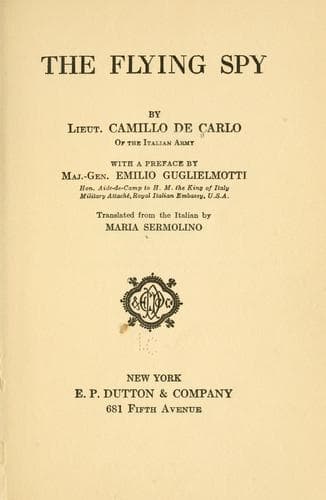
World War, 1914-1918 -- Personal narratives, Italian
With the evening bulletin Brunora also sent me my legitimization paper
and one for Bottecchia. From it I gathered that I was thirty-five, that
I was a peasant, that I could not speak German. To make it valid I had
to place the print of my thumb in a certain place, and the thoughtful
secretary had provided even for this by sending me some blotting paper
soaked in copying ink. I pressed my finger on the paper and made a
fingerprint under my signature. Of course, while signing my name I
tried to change my handwriting in imitation of the irregular writing of
the peasants and smilingly I admired the round puffy “P” with which I
began my name. I practiced copying my name so that I should be able to
write it always in the same way. This paper enabled me at last to
wander about, and I decided to go on the following morning, before it
was time to place the signals, as far as Sarmede where there was a
large enemy auto-park and great movements of troops and material.
XV
On the following morning (June 17th), I went to Sarmede as I had
planned. With my jacket on my shoulder and my slow weary step, imitated
from that of the mountaineers, I did not arouse any suspicion, and
passed unnoticed.
All the streets were congested with a great deal of material and the
small number of wagons at the disposal of the Austrians surprised me.
They made great use of heavy steam tractors for hauling ordnance, and
as I was hiding behind a group of trees, I saw a long procession of
cannon, all covered with leaves, pass, which from their bulk looked
like “305’s.” These troops and this material seemed directed towards
the lower Piave. The roads were also congested by auto-ambulances full
of wounded, and wagons transporting the slightly wounded. In several
places the movement was so great and so badly regulated that the long
lines of cars had to stand still for some time to open up a passage for
other columns going in the opposite direction. The Austrians also made
extensive use of little low wagons with broad wheels, drawn by
Hungarian ponies which were lean and seemed to have suffered a great
deal. The freight belonged to the 41st army corps which was the one
operating towards the Grave di Pappadopoli and which had not succeeded
in passing.
Public-domain text, read in full here on John Shaqi.
Reviews
Reviews
No reviews yet
Be the first to share your thoughts on this work.
Elsewhere in the archive