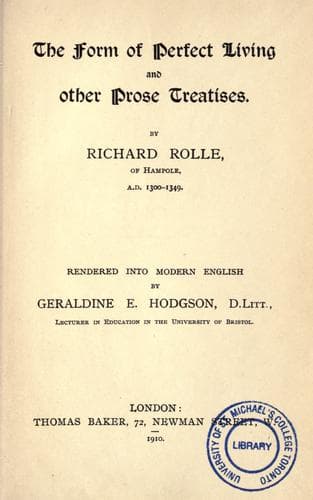
The Form of Perfect Living and Other Prose TreatisesRolle, Richard, of Hampole
Religion
The Form of Perfect Living and Other Prose Treatises
Rolle, Richard, of Hampole
Christian life; Rolle, Richard, of Hampole, 1290?-1349
The fourth asking was: _how thou mightest know that thou wast in love
and charity_. I answer: that no man wots on earth that they are in
charity; save it be through any privilege or special grace that GOD has
given to any man or woman: that all others may not take example by. Holy
men and women trow that they have truth and hope and charity: and in
that do as well as they may, and hope certainly that they shall be safe;
they wot it not so quickly; for if they wish, their merit were the less.
And Solomon says it is so with righteous men and wise men, and that
their works are in GOD'S hand. And nevertheless, a man wots not whether
he be worthy hatred or love; but all is reserved uncertain for another
world. Nevertheless, if any had grace that he might win to the third
degree of love, which is called _Singular_, he should know that he was
in love. But in such manner were the knowing, that he might never bear
himself the higher, nor be in less care to love GOD; but so much the
more that he is secure of love, will he be busy to love Him and dread
Him, Who has made him so, and done that goodness to Him; and he that is
so high, he will not hold himself worthier than the sinfullest man that
goes on earth. Also seven experiments are there, that a man be in
charity. The first is; when all covetousness of earthly things is
quenched in him. For whereso covetousness is, is no love of Christ.
Then, if he have no covetousness, sign is that he has love. The second
is, burning yearning for heaven. For when men have felt aught of that
savour, the more they love, the more they covet: and he that has not
felt, he desires not. Therefore, when anyone is given so much, till he
love thereof (so) that he can find no joy in his life: token has he that
he is in charity. The third is; if his tongue be changed, that was wont
to speak of earth; now speaks of GOD, and of the life that lasts aye.
The fourth is: exercise of ghostly profit. As if any man or woman give
themselves entirely to GOD'S services, and meddle with no earthly
business. The fifth is: when the thing that is hard of itself seems
light for to do; the which love makes. For as Austin says: "Love it is
which brings the far thing near-to-hand, and the impossible to the
openly possible." The sixth is: hardness of thought to suffer all
anguish and hurt that comes--without this, all the other suffices not.
For whatso befalls him shall not make a righteous man sorry. For he who
is righteous, hates naught but sin; he loves naught but GOD, before GOD:
he dreads naught but to anger GOD. The seventh is: delectability in
soul, when he is in tribulation, and makes praise to GOD in the anger
that he suffers. And this shews well that he loves GOD, when no sorrow
can bring him down. For many love GOD while they are at ease; and in
adversity they grumble, and fall into so great sorriness, that scarcely
may any man comfort them: and so slander they GOD, striving and fighting
against His judgments.
Public-domain text, read in full here on John Shaqi.
Reviews
Reviews
No reviews yet
Be the first to share your thoughts on this work.
Join the Discussion
Join the discussion
Sign in to leave a comment or review.
Sign InorCreate an account