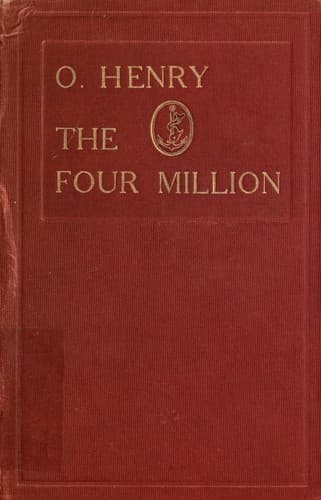
New York (N.Y.) -- Social life and customs -- Fiction; Short stories, American
First Mrs. Parker would show you the double parlours. You would not
dare to interrupt her description of their advantages and of the merits
of the gentleman who had occupied them for eight years. Then you would
manage to stammer forth the confession that you were neither a doctor
nor a dentist. Mrs. Parker’s manner of receiving the admission was such
that you could never afterward entertain the same feeling toward your
parents, who had neglected to train you up in one of the professions
that fitted Mrs. Parker’s parlours.
Next you ascended one flight of stairs and looked at the
second-floor-back at $8. Convinced by her second-floor manner that it
was worth the $12 that Mr. Toosenberry always paid for it until he left
to take charge of his brother’s orange plantation in Florida near Palm
Beach, where Mrs. McIntyre always spent the winters that had the double
front room with private bath, you managed to babble that you wanted
something still cheaper.
If you survived Mrs. Parker’s scorn, you were taken to look at Mr.
Skidder’s large hall room on the third floor. Mr. Skidder’s room was
not vacant. He wrote plays and smoked cigarettes in it all day long.
But every room-hunter was made to visit his room to admire the
lambrequins. After each visit, Mr. Skidder, from the fright caused by
possible eviction, would pay something on his rent.
Then—oh, then—if you still stood on one foot, with your hot hand
clutching the three moist dollars in your pocket, and hoarsely
proclaimed your hideous and culpable poverty, nevermore would Mrs.
Parker be cicerone of yours. She would honk loudly the word “Clara,”
she would show you her back, and march downstairs. Then Clara, the
coloured maid, would escort you up the carpeted ladder that served for
the fourth flight, and show you the Skylight Room. It occupied 7×8 feet
of floor space at the middle of the hall. On each side of it was a dark
lumber closet or storeroom.
In it was an iron cot, a washstand and a chair. A shelf was the
dresser. Its four bare walls seemed to close in upon you like the sides
of a coffin. Your hand crept to your throat, you gasped, you looked up
as from a well—and breathed once more. Through the glass of the little
skylight you saw a square of blue infinity.
“Two dollars, suh,” Clara would say in her half-contemptuous,
half-Tuskegeenial tones.
One day Miss Leeson came hunting for a room. She carried a typewriter
made to be lugged around by a much larger lady. She was a very little
girl, with eyes and hair that had kept on growing after she had stopped
and that always looked as if they were saying: “Goodness me! Why didn’t
you keep up with us?”
Mrs. Parker showed her the double parlours. “In this closet,” she said,
“one could keep a skeleton or anaesthetic or coal—”
“But I am neither a doctor nor a dentist,” said Miss Leeson, with a
shiver.
Public-domain text, read in full here on John Shaqi.
Reviews
Reviews
No reviews yet
Be the first to share your thoughts on this work.
Join the Discussion
Join the discussion
Sign in to leave a comment or review.
Sign InorCreate an account