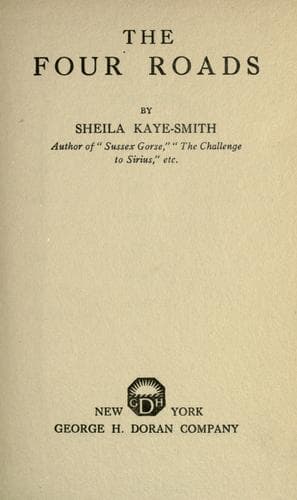
Sussex (England) -- Fiction; World War, 1914-1918 -- England -- Fiction
During the earlier years she had, in company with most people in the
country of the Four Roads, passed lightly under its yoke. Even her
widowhood had not brought it down upon her—Sam had so often left
her, might so easily have come to grief in other ways. Except for
those who were actually and poignantly bereaved, the War made little
difference to a large multitude for whom it existed only in France
and in the newspapers. For a big section of England it did not begin
till 1916, for it was not till then that it actually set foot on
English soil. In 1916 the Conscription Act, the food scarcity, and
War Agricultural Committees dumped it down on the doorsteps of Sussex
folk who up till then had ignored it as a furrin business. Thyrza
had not thought about it much—she had read the newspapers, and given
little bits of help to war charities that appealed to her; but now
that it had taken the man she loved, it had taken her too. She was
tied with him to its chariot-wheels, one of the nameless victims of
the great woe.
Her business, too, fretted her. She was not able for the exertions of
the times, and was worried by the difficulties of getting supplies.
To have no sweets for the little children who came in with their
pennies, no tea for the old men and women who wanted it to warm and
cheer their poor rheumatic bodies, no cheese and no bacon for the
young men who worked in the fields ... all this grieved her gentle
heart, and she brooded over it in a way she would not have done had
she been in her usual health. She grew pale and nervous, found she
had but little to say to lingering customers, sat huddled limply over
her fire, rising slowly and heavily when the buzz of the little bell
that used to be so gay forced her to exert herself and go to the door.
In this state, Mrs. Beatup took pity on her, and forgot the tacit
warfare of the mother on the wife. If Thyrza was going to give a
child to Tom, she was also going to give a grandchild to Tom’s
mother. She often waddled down to the shop with good advice, or asked
Thyrza up for an evening at Worge, and developed a new and unexpected
optimism for her comfort.
“Reckon if Tom’s alive he’ll stick alive to the end—if he’d bin going
to be killed he’d have bin killed afore now. Besides, he always wur
the chap fur luck. I remember how when he wur a liddle feller he
slid into the pond, and we all thought he’d be drownded, but Juglery
pulled him out, and his faather hided him nigh out of his skin. So
doan’t you vrother, my dear, but kip in good heart fur the saake of
the liddle ’un wot’s coming. Tom ull live to see un, I can promise
you. He sims unaccountable young to have a baby, but reckon he’d be
younger still to die.”
2
Public-domain text, read in full here on John Shaqi.
Reviews
Reviews
No reviews yet
Be the first to share your thoughts on this work.
Elsewhere in the archive
Join the Discussion
Join the discussion
Sign in to leave a comment or review.
Sign InorCreate an account