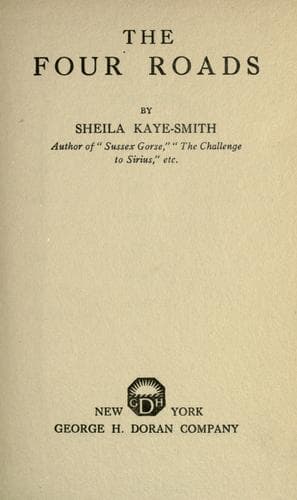
Sussex (England) -- Fiction; World War, 1914-1918 -- England -- Fiction
He would have been rightly offended if anyone had told him that his
chief pangs of parting were for the farm. None the less, there was
a lingering wistfulness in his last dealings with it which was not
in his intercourse with his family. He loved his mother, he admired
his father, he felt for his brothers and sisters an elder brother’s
half-anxious, half-contemptuous fondness; but in his last services
for Worge, whether in field or barn, there was something almost
sacramental. His duties were rites—he was the unconscious priest of
that tumble-down altar before which the manure smoked as incense and
on which the burnt-offering of his boyhood lay.
He had, too, a hunger for the fields, not only the fields of Worge,
but for all those within the Four Roads—which he did not see as
roads leading to adventure, but as boundaries fencing home. When his
tasks allowed he would roam in the webbing of tracks that the farms
have spun between the lanes—he would go to Starnash or Oxbottom
Town, watch the lightless sky grow purple over Muddles Green, and
the big stars begin to spark it as the moon hung like a red lamp
above Mystole Wood. High on the zenith the sky would be rainy green,
and he would watch it deepen to purple round the crimson moon, all
unconscious of its beauty, loving it only because it hung above
this clay in which his feet were stuck, because from it came the
brightness which waked the homely things he had put in the earth to
sleep....
Sometimes he would be disturbed by another quest, and would beat
slowly up and down on the road outside the shop, longing to go in
and yet strangely reluctant. He felt all tied-up and dumb. He could
not tell Thyrza Honey what he felt at leaving her any more than
he could have told Starnash or Thunders Hill—than he could have
told the little brother who lay against him on cold nights—or the
dreamy-eyed cows he milked—or even the grinning, whining watch-dog
who muddied him with his love. He was dumb, as all these were dumb.
He felt unaccountable vrothered at having to leave them all, and that
was the utmost he could say; and yet he knew that in Thyrza’s case,
at any rate, it was not enough. A man with a better tongue than he
would have gone into that shop, and shut himself into the light and
tea-smelling warmth, instead of pacing up and down under the cold
stars.
9
On the last day of all he plucked up courage. He could not go without
saying good-bye, and he had always brought her the big things of his
life—from his buying of a horse-rake to the news of the Tribunal’s
decision—though each time he had wrapped his need in some penny
purchase of tobacco or sweets.
Public-domain text, read in full here on John Shaqi.
Reviews
Reviews
No reviews yet
Be the first to share your thoughts on this work.
Join the Discussion
Join the discussion
Sign in to leave a comment or review.
Sign InorCreate an account