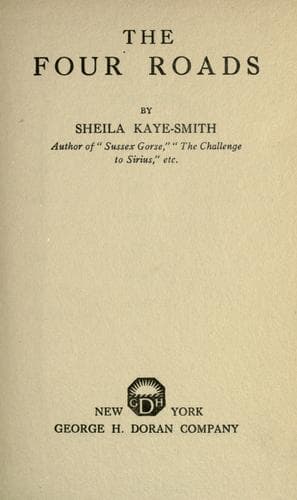
Sussex (England) -- Fiction; World War, 1914-1918 -- England -- Fiction
Harry felt rather ashamed, and tried hard to atone the next day by
working himself sick. Mrs. Beatup and Ivy helped too, since haymaking
was the one kind of field work which the women did not feel it
derogatory to perform. Ivy was a whacking girl, nearly as good as a
man; but Mus’ Beatup would never have dreamed of asking her to help
fill Tom’s empty place. If town girls thought so little of themselves
as to enrol for farm work, that was no concern of his, but he was
hemmed if he’d have his wife and daughter meddling with anything
beyond the fowl-house, and as for employing other women whose dignity
mattered less to him—and, apparently, to themselves—he’d sooner Worge
went to the auctioneer’s, just to teach the government a lesson.
4
So Worge muddled through its haymaking, and then the shearing; and
Harry was sometimes idle and sometimes industrious, and Mus’ Beatup
was sometimes drunk and sometimes sober. The oats in the Street Field
and the field at the back of the Rifle Volunteer were slowly parching
to the colour of dust, though thick green shadows rippled in them,
and told how far off still the harvest was. They were spring-sown
potato-oats, chosen by Tom on account of their vigorous constitution,
though otherwise not very well suited to the clays of Sunday Street.
He had manured them at their sowing with rape-cake, nursed their
first sproutings, and now in every letter enquired after their
progress. “Keep an eye on them, dear father, for the Lord’s sake, and
do not let them stand after they’re ripe, or they will shed there
seeds for certain sure, being potatos.”
Tom had been some weeks now at Waterheel in the Midlands, a private
in the Sussex Regiment, with an elaborate and mystifying address,
which his family found the greatest difficulty in cramming into the
envelope. They did not write to him as often as he wrote to them, in
spite of the fact that they were six to one. But then they were not
far from home, dreaming of the old fields, longing for the old faces.
On the whole though, Tom was happy enough. He found his new life
strange, but not totally uncongenial. A comfortable want of
imagination made it possible for him to put Worge out of mind, now
that it was also out of sight, and he was among lads of his own age,
old acquaintances some of them—Kadwell of Stilliands Tower, and two
Viners from Satanstown, Bill Putland, Jerry Sumption. There was Mus’
Archie, too, with a nod and a kind word now and then to intensify
that “feeling of Sussex chaps” which was not quite such an uncommon
one now; and there was Mus’ Dixon, Mus’ Archie’s elder brother, who
had lived in London and written for the papers before the War, and
now used his sword to cut the leaves of books—so his orderly said—yet
was a brave man none the less, and a good officer, though he hated
the life as much as his brother loved it.
Public-domain text, read in full here on John Shaqi.
Reviews
Reviews
No reviews yet
Be the first to share your thoughts on this work.
Join the Discussion
Join the discussion
Sign in to leave a comment or review.
Sign InorCreate an account