The Fourteenth of July, and Danton: Two Plays of the French Revolution — John Shaqi
The Fourteenth of July, and Danton: Two Plays of the French RevolutionRolland, Romain
History
The Fourteenth of July, and Danton: Two Plays of the French Revolution
Rolland, Romain
France -- History -- Revolution, 1789-1799 -- Drama
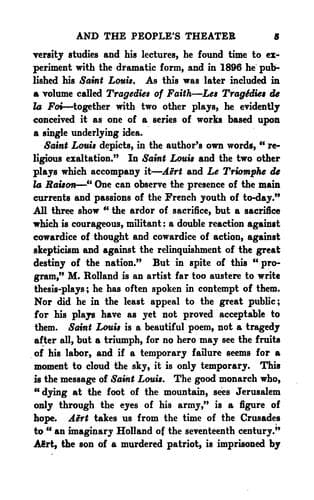
In order to grasp the full significance of M. Holland's plays
it will be necessary to consider his interesting book, _Le
Théâtre du Peuple._ Ever since the early eighties M. Holland
had been a staunch admirer and in some ways a disciple of
Tolstoy. The young Frenchman, however, expressed his doubts
to the Russian, and in 1887 Tolstoy wrote a long letter which
was, according to one of M. Holland's biographers, a sort of
preliminary sketch for _What Is Art?_ And when that astounding
book appeared, with its iconoclastic attacks on M. Holland's
idols, he was at first prone to disagree, but _Le Théâtre du
Peuple_ is ample proof that "literature for the people" had sunk
deep into the Frenchman's heart. The theater, in common with
most modern art, is a whitened sepulcher, rotten to the core,
affected, aristocratic, anti-democratic. The evil is not only
in the plays, but in acting and the physical arrangement of the
playhouse itself. New plays must be written for the masses,
plays which they can understand, plays which bring them together
as a class and in which they can participate. M. Rolland
briefly considers the dramatic masterpieces of the world, from
Sophocles to the comedies of the boulevard, and finds them, with
rare exceptions, unsuited to the people. Even Shakespeare and
Schiller are lifeless: they belong to past epochs, and express
ideas foreign to the French workingmen of the twentieth century.
The playhouses, too, are built for a society divided into
classes; these must be altered to suit the workingmen. Says M.
Rolland in the preface to the first edition: "Of late there has
been an attempt to found a People's Theater in Paris. Already
personal and political interests have begun to make themselves
evident. But we must unflinchingly destroy the parasites who
seek a living at the expense of our theater. The People's
Theater is not a fashionable toy; it is no game for dilettanti.
It is the imperious expression of a new society, its voice and
thought; it is, as a result of circumstances, the war-machine
against an ageing and fossilized society. Let there be no
misunderstanding: we must not merely open up new old theaters,
bourgeois theaters endeavoring to appear new merely by calling
themselves people's theaters. We must found a theater by and for
the people, a new art for a new world."
Public-domain text, read in full here on John Shaqi.
Reviews
Reviews
No reviews yet
Be the first to share your thoughts on this work.
Join the Discussion
Join the discussion
Sign in to leave a comment or review.
Sign InorCreate an account