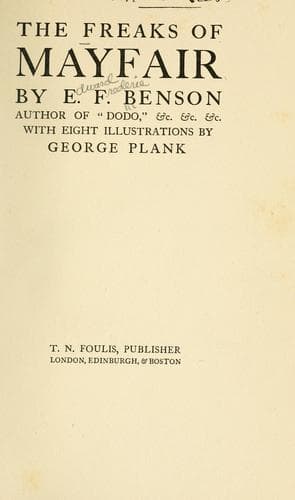
The Freaks of MayfairBenson, E. F. (Edward Frederic)
General
The Freaks of Mayfair
Benson, E. F. (Edward Frederic)
England -- Social life and customs -- 20th century -- Fiction; Humorous stories, English; Short stories, English
Horace Campbell has an unerring gift of smudging whatever he speaks of.
As he speaks most of the time, he manages to smudge a good deal, and in
consequence is in great demand at somewhat smudgy houses by reason of
his appropriate and amusing conversation. Every decent man would like to
kick him, and every nice woman would like to slap his fat white face,
and so his habitats are the establishments of those not so foolishly
particular. But though he lunches and dines without intermission at
other people’s houses, he is in no degree one who sings for his dinner,
for he has a quite distinct career of his own, and spends his mornings
earning not daily bread only, but truffles and asparagus and all the
more expensive foods, by teaching other people to sing. His knowledge of
voice-production is quite unrivalled, and he could probably, if he
chose, turn a corn-crake into a contralto. The enormous fees that he
charges thus enable him to compress into three hours the period of his
working day, and during that time he is the father and mother of most of
the beautiful noises that next year will be heard rising from human
throats at concerts and opera-houses. Then, his business being over and
his pocket fat, he puts on his black morning coat, and his cloth-topped
shoes, his grey silk tie with the pearl tie-pin, and goes forth to cause
himself as well as his pocket to grow fat, and makes a music of his own.
Now his thesis, his working hypothesis, the basis of his conversation,
is this. There are always several possible causes which may account for
all that happens in the busy little world of London, and in discussing
such happenings, he invariably assumes the smudgiest and more scandalous
cause. A few instances will make this clear.
Example (1): John Smith is engaged to Eliza Jones.
Possible causes:
(i.) John Smith loves Eliza Jones and Eliza Jones loves John Smith.
(ii.) John Smith is after Eliza Jones’s money.
(iii.) It was high time that John Smith _did_ marry Eliza Jones.
Of these possible causes Horace Campbell leaves cause (i.) out of the
question as not worth consideration. Cause (ii.) may account for it, but
he invariably prefers cause (iii.).
Or again--
Example (2): Mrs. Snookes went to the opera with Mr. Snookes.
Probable causes:
(i.) Husband and wife went to the opera because they like going to the
opera.
(ii.) Mrs. Snookes has an affair with the famous tenor Signor Topnotari.
(iii.) Mr. Snookes is paid £2:2:0 a night to applaud the soprano Signora
Beeinalt.
It is idle to point out which cause Horace Campbell proceeds to discuss.
Example (3): An eminent statesman goes into the country for a week-end.
Possible causes:
(i.) The eminent statesman needs rest.
(ii.) ‘Somebody’ goes with him.
Horace Campbell’s law of causation again applies.
Public-domain text, read in full here on John Shaqi.
Reviews
Reviews
No reviews yet
Be the first to share your thoughts on this work.
Join the Discussion
Join the discussion
Sign in to leave a comment or review.
Sign InorCreate an account