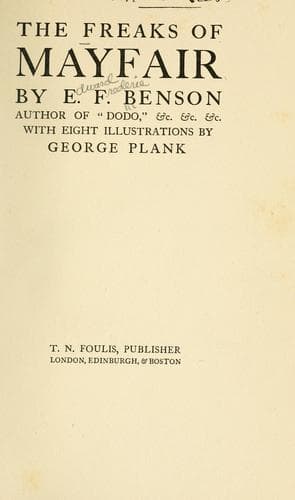
The Freaks of MayfairBenson, E. F. (Edward Frederic)
General
The Freaks of Mayfair
Benson, E. F. (Edward Frederic)
England -- Social life and customs -- 20th century -- Fiction; Humorous stories, English; Short stories, English
His ecclesiastical politics, as exhibited in the services at St.
Sebastian’s, are distinctly High. But they are also Broad, since for
those of his parishioners who prefer it, there is an early celebration
at 8 A.M. conducted by two of his curates. Matins, sung in plain-song by
an admirable choir, follows at 10 A.M., and this is usually attended by
a packed congregation. By eleven, in any case, which is the hour for the
sermon, there is not a seat to be had in the church, for Mr. Sandow
invariably preaches himself, and from Pimlico and the wilds of South
Kensington, from Bayswater and Regent’s Park, eager listeners flock to
hear him. This is no quarter of an hour’s oration: he seldom preaches
less than fifty minutes, and often the large Louis Seize clock below the
organ loft, with its discreetly nude bronze figures of Apollo and Daphne
in the vale of Tempe sprawling over it, chimes noon on its musical bells
before he has finished. A short pause succeeds the conclusion of the
sermon, and the choir enters the church again from the vestry in
magnificent procession and panoply of banners, followed by the clergy in
full vestments. Clouds of the most expensive incense befog the chancel,
and if what is enacted there is not the Mass, it is an uncommonly good
imitation of it.
Mr. Sandow’s ecclesiastical doctrines thus preach themselves, so to
speak, in the manner of this service, and there is little directly
doctrinal in his sermons. He ranges the religions of the world, culling
flowers from Buddhism, Mohammedanism, Fire Worship, Christian Science,
and has even been known to find something totemistic, if not positively
sacramental, in the practice of cannibalism. The first part of these
sermons is always extremely erudite, and out of his erudition there
springs a sort of sunlit Pantheism. He splits no hairs over it, and does
not insist on any definitely limited meaning being attached to the word
‘immanent’; it satisfies him to prove the pervasiveness of Deity. At
other times, instead of rearing his creed as this substructure of
world-religion, he mines into the sciences and gives his congregation
delightful glimpses into the elements of astronomy, with amazing figures
as to the distance of the fixed stars. Or he investigates botany, and
Aquilegia rolls off his tongue as sonorously as Aldebaran. Out of the
arts as well, from music, painting, sculpture he delves his gold, that
gold which he finds so freely distributed throughout the entire
universe. Having got it, he becomes the goldsmith, and shows his
listeners how to turn their lives into wondrous images of pure gold,
the gold of the complete consciousness that there is nothing in this
world common or unclean, or less than Divine. He snaps his fingers in
the face of Satan, and tells him, as if he was a mere Mrs. Harris, that
there is no ‘sich a person.’ All is divine, and therefore we must set
about our businesses with joy and exultation. Not only will sorrow and
Public-domain text, read in full here on John Shaqi.
Reviews
Reviews
No reviews yet
Be the first to share your thoughts on this work.
Elsewhere in the archive
Join the Discussion
Join the discussion
Sign in to leave a comment or review.
Sign InorCreate an account